

- New
- July 18, 2026
Fiber Cement Cladding & Facade Panels for UAE Building Exteriors
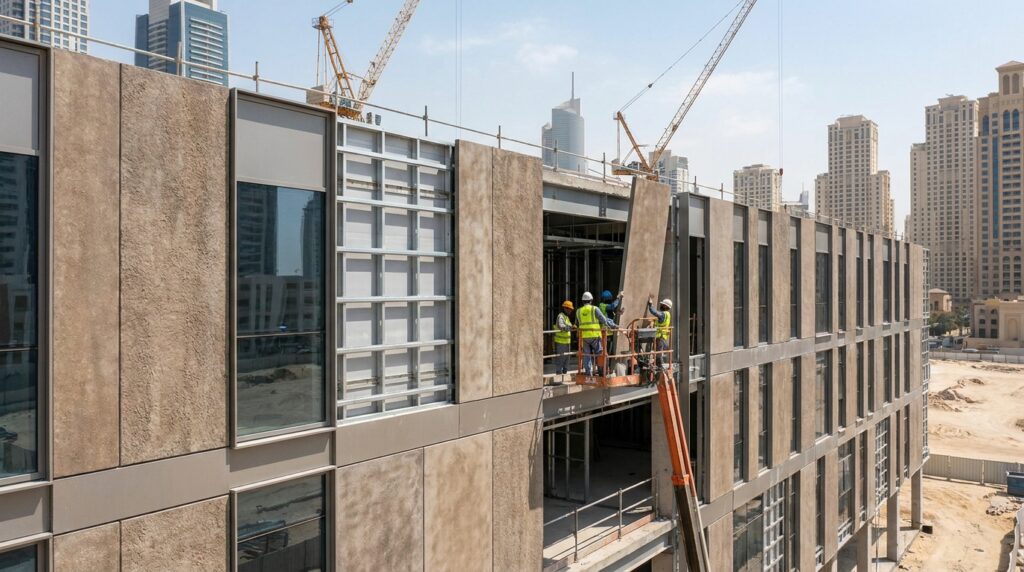
Choosing external wall cladding in the UAE is not just a design decision. It is a compliance decision. Since 2017, Dubai Civil Defence has prohibited combustible cladding materials on new buildings following a series of high-rise facade fires. The rules are clear: external cladding must be non-combustible.
Fiber cement cladding that the UAE architects and developers specify meets that requirement by composition. It is cement, sand, and cellulose fiber. It does not burn. It does not melt. It does not produce toxic smoke.
That is the starting point. This guide covers everything else you need to know before specifying FCB for an exterior facade in the UAE.
At a Glance
Why External Cladding Is a High-Stakes Decision in the UAE
The UAE climate attacks building exteriors from multiple directions at once. Temperatures climb above 45 degrees Celsius in summer. Coastal air carries salt and humidity. Dust storms create abrasive conditions across the building skin. UV radiation is intense year-round.
Add the fire code requirements, and the decision becomes even more specific. A cladding panel needs to handle all of the above while meeting non-combustibility standards that are reviewed at the approvals stage.
Get it wrong, and the consequences show up in three ways.
- Compliance rejection during permit review.
- Premature material failure on the facade.
- Costly remedial work after handover when panels warp, crack, or fail under weather exposure.
What Makes Fiber Cement Cladding Suited to UAE Exteriors
Non-combustibility. FCB is made from inorganic materials. Cement and sand do not burn. The cellulose fiber content is minimal and fully encapsulated within the cement matrix. The result is a panel that is non-combustible and does not contribute to flame spread. This satisfies Dubai Civil Defence requirements for external cladding materials on new buildings.
Dimensional stability. Metal facade panels expand and contract with temperature. In the UAE, where the swing between a summer afternoon and a winter night can exceed 30 degrees, this movement is significant. FCB expands and contracts at a much lower rate. Panels stay flat. Joints stay sealed. The facade does not develop the buckling or gap problems that metal panel systems can show after a few years of thermal cycling.
Moisture resistance. FCB does not absorb water. Rain, coastal humidity, and wind-driven moisture pass off the surface without penetrating the panel. This matters particularly in Abu Dhabi and coastal areas along the Northern Emirates, where humidity is sustained, and salt air adds to the deterioration of materials that are not built for it.
Impact and abrasion resistance. Dust storms in the UAE carry sand particles that abrade softer surface materials over time. FCB has a hard, dense face that sheds abrasive particles without eroding. The surface remains intact after years of exposure that would visibly damage paint, composite panel faces, or softer cladding products.
Weight. High-density FCB cladding panels weigh significantly less than stone, marble, or precast concrete facade systems. This reduces the load on the sub-frame and on the building structure. On large facade areas, the weight saving is meaningful for both structural design and installation logistics.
While this guide focuses on exterior facades, fiber cement boards are equally effective for interior partitions, ceilings, wet areas, and commercial fit-outs. Explore our guide on Fiber Cement Board Applications: Interior & Exterior Uses in UAE Buildings to discover where FCB delivers the best performance across different construction projects.
Fiber cement boards are equally effective for durable interior wall systems. Learn more in our guide on Fiber Cement Board for Wall Partition Systems in UAE Offices & Homes.
External Wall Cladding Dubai: Fire Code Compliance
This is where FCB has a clear technical advantage over some of the most widely used cladding materials in the UAE market.
Aluminium composite panels with polyethylene cores were responsible for rapid fire spread on several UAE high-rise buildings before the 2017 code change. The code now requires non-combustible external cladding on new buildings. Older buildings with combustible cladding are being urged to retrofit, and Dubai Civil Defence continues to pressure building owners to comply.
FCB does not need a combustibility test to prove a negative. It is non-combustible by nature. It achieves the fire performance requirement through its composition, not through coatings or treatments that could be damaged or skipped during installation.
One important note: UAE fire code requires the full cladding assembly to be tested, not just the panel alone. The sub-frame, fixings, insulation layer, and panel together form the tested system. Specify the panel from a supplier who can provide tested assembly documentation, not just a product data sheet for the board alone.
Facade Panel Supplier UAE: What to Ask Before You Buy
The FCB cladding market in the UAE includes locally manufactured boards and imported products. The source matters more than most buyers realise. Locally manufactured FCB arrives without import freight costs, port delays, or the currency risk that comes with overseas orders. Lead times are shorter. Stock availability is more predictable. For contractors managing tight construction programs, this is a real advantage.
When evaluating a facade panel supplier for UAE projects, ask for the following before committing to a specification.
- Fire classification documentation for the fully tested assembly, not just the panel alone.
- Density rating and thickness tolerances are verified on the product data sheet.
- Moisture resistance classification for external applications. Not all FCB is rated for outdoor use. Verify the external grade specification before ordering.
- Thermal movement data. Know how much the panel expands per degree of temperature change and design the joint widths accordingly.
- Technical support for sub-frame and fixing design. A supplier who cannot provide this is leaving the most critical installation details to the contractor to figure out on-site.
Weatherproof Exterior Cladding Abu Dhabi: The Sub-Frame and Fixing System
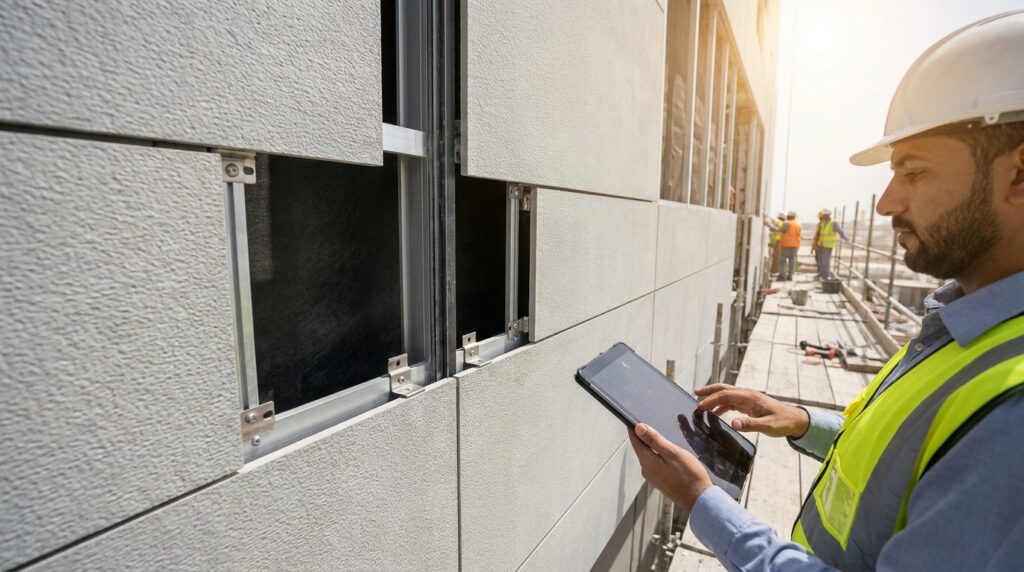
The panel is only half the facade system. The sub-frame and fixing system determine how long the panel performs, how water is managed, and whether the facade stays aligned over years of thermal movement.
Sub-frame material. Aluminium is the standard choice for external wall sub-frame systems in the UAE. It does not corrode, handles thermal expansion with appropriate joint design, and carries the panel load without adding significant weight to the structure. Galvanised steel sub-frames are used in some applications but require careful specification in coastal environments where salt air increases corrosion risk.
Fixings. Use stainless steel or corrosion-resistant fixings only. Standard galvanised screws corrode in UAE coastal conditions, stain the panel face, and eventually fail structurally. This is one of the most common installation errors on external cladding jobs and one of the most avoidable.
Drainage cavity. A rainscreen cavity behind the cladding panels allows any moisture that gets past the outer face to drain away rather than sit against the wall. The cavity also allows air movement, which reduces heat build-up behind the facade. Design the weep holes at the base so the drainage path is clear from the top of the wall to the bottom.
Expansion joints. FCB panels need to have designed expansion gaps between sheets to accommodate thermal movement. Fill the gaps with a flexible, UV-stable sealant. Rigid filler in an expansion joint cracks and allows water ingress within the first few temperature cycles.
Panel edge sealing. Cut edges on FCB panels expose the cement and fiber matrix to direct moisture ingress. Seal all cut edges with a compatible edge sealant before installation. This step is often skipped on site and leads to moisture entry at the panel perimeter.
For projects requiring durable exterior soffits and moisture-resistant ceiling systems, read our guide on Using Fiber Cement Board for False Ceiling: Interior & Exterior UAE.
FCB Cladding vs ACP: The Honest Comparison
Aluminium composite panels remain widely used in the UAE for facade applications. The right ACP specification with a non-combustible mineral core is code-compliant. But there are practical differences worth knowing.
ACP panels are lighter and can span longer distances between fixings, which simplifies sub-frame design on very large facades. They are also more easily formed into curved or complex shapes for architectural feature facades.
FCB cladding is heavier per square meter and is better suited to flat or simple facade geometries. Where FCB holds an advantage is in long-term surface durability, dimensional stability under thermal cycling, and cost. FCB panels generally cost less than non-combustible mineral-core ACP, and the surface does not show the panel-edge corrosion issues that cut ACP panels can develop over time.
For straightforward commercial and residential facades where budget, compliance, and long-term performance are the priorities, FCB is a strong specification. For architecturally complex facades with curves, folds, and large spans, ACP with a compliant core may be the more practical choice.
Fiber cement boards are equally valuable in prefab and modular construction, offering durable solutions for wall panels and building envelopes. Learn more in Fiber Cement Board for Prefab & Modular Construction in UAE.
Conclusion
Fiber cement cladding UAE buildings use for exterior applications is non-combustible, dimensionally stable, resistant to moisture and abrasion, and competitively priced against alternatives that need significant treatment or testing to meet the same fire code requirements.
Getting the facade right means specifying the right grade of FCB for external use, designing the sub-frame and fixing system correctly, and sourcing from a supplier who can provide full assembly documentation for approvals. Those three steps are where most facade problems begin when they are not done properly.
Fibre cement boards are not only ideal for exterior facades but also for moisture-prone interior spaces. Read our guide on Cement Board for Wet Areas: Bathrooms, Kitchens & Pool Surrounds in UAE to discover why they’re widely used in bathrooms, kitchens, and pool surrounds across the UAE.
To discuss fiber cement cladding specifications for your next UAE project, contact Geminite using this contact form.
Frequently Asked Questions
What is fiber cement cladding and why is it used in the UAE?
It is a non-combustible external wall panel made from cement, sand, and cellulose fiber, used in the UAE for its fire compliance, weather resistance, and dimensional stability in extreme heat.
Does fiber cement cladding meet Dubai Civil Defence fire code requirements?
Yes. FCB is non-combustible by composition and satisfies the requirements for external cladding materials on new buildings under the UAE fire and life safety code.
What thickness of FCB is used for external wall cladding in Dubai?
External cladding applications typically use FCB panels from 8mm to 18mm depending on the panel span, fixing system, and structural requirements of the facade design.
Is fiber cement cladding suitable for weatherproof exterior cladding in Abu Dhabi coastal areas?
Yes. FCB does not absorb moisture, resists salt air, and remains dimensionally stable in the heat and humidity conditions along the UAE coast.
What fixings should be used for an FCB facade panel system?
Stainless steel or corrosion-resistant fixings only. Standard galvanised screws corrode in UAE coastal conditions and eventually compromise the facade.
How does fiber cement cladding compare to ACP for external wall cladding in Dubai?
FCB is heavier but costs less, requires no combustibility testing, and is more dimensionally stable under thermal cycling than ACP panels with mineral cores.
Does FCB require a drainage cavity behind the panels on an exterior facade?
Yes. A rainscreen cavity allows moisture to drain away from the wall and reduces heat build-up behind the facade, which extends the life of both the panel and the substrate.
Can fiber cement facade panels be painted on site?
Yes, but a cement-specific alkali-resistant primer must be applied first. Paint applied directly to unprimed FCB will peel, particularly under the UV and heat exposure of a UAE exterior.
How does fiber cement cladding handle UAE dust storms?
The dense cement surface sheds abrasive sand particles without eroding, which keeps the facade intact over years of exposure that would visibly damage softer panel materials.
What documentation should a facade panel supplier for UAE projects be able to provide?
Fire classification for the fully tested assembly, density and thickness data, moisture resistance rating for external grade product, thermal movement values, and technical guidance on the sub-frame and fixing system.
At a Glance