

- New
- July 20, 2026
Cement Board for Wet Areas: Bathrooms, Kitchens & Pool Surrounds in UAE
Bathrooms, kitchens and pool surrounds experience continuous exposure to moisture and are therefore considered to be one of the most challenging parts of any building. Mould, warped surfaces, loose tiles, and expensive repairs can be the result of poor selection of wallboard in the hot and humid climate of the UAE. That is why many builders, architects, and homeowners prefer cement board for bathrooms UAE for long-lasting performance.
At Geminite, we offer quality fibre cement boards that are designed to work under the harsh weather conditions in UAE. Whether constructing a new house, renovating your bathroom, or developing a commercial work, the selection of the correct cement board assists you in designing a strong and waterproof foundation. This guide will teach you why cement board bathrooms UAE are the best to use in bathrooms, kitchens and pool surrounds, some installation advice and tips to achieve long-term durability.
At a Glance
Why Choose Cement Board for Wet Areas?
A cement board for bathrooms UAE is made from cement reinforced with fibres. It does not readily absorb water, warp, or rot like gypsum boards or plywood. This makes it a perfect choice in wet conditions.
The increasing use of fibre cement products in construction is shown by the rising demand. Grand View Research suggests that the global fibre cement board market will be USD 12.09 billion in 2023, and will hit USD 27.19 billion by 2030, with a CAGR estimate of 12.5%.
This consistent progress underscores the rising popularity of fibre cement boards due to durability, resistance to moisture and extended service life in both residential and commercial premises.
Some of its major benefits include:
- Excellent moisture resistance
- Excellent ceramic and porcelain tiles.
- Fire-resistant construction
- Long service life
- Suitable for both indoor and outdoor applications
- Low maintenance requirements
Why It Performs Better Than Traditional Materials
Gypsum boards or plywood behind tiles are still used in many bathrooms. These materials might be cheaper in the short run, although they tend to wear out when exposed to water.
A cement board for bathrooms UAE offers several long-term advantages:
|
Feature |
Cement Board |
Gypsum Board |
|
Moisture resistance |
Excellent |
Poor |
|
Tile support |
Strong |
Limited |
|
Fire resistance |
High |
Moderate |
|
Life expectancy |
Long |
Short in wet areas |
|
Suitable for bathrooms |
Yes |
No |
For projects that require long-lasting performance, a cement board for bathrooms UAE is the better investment.
Application of Cement Board in Bathrooms.
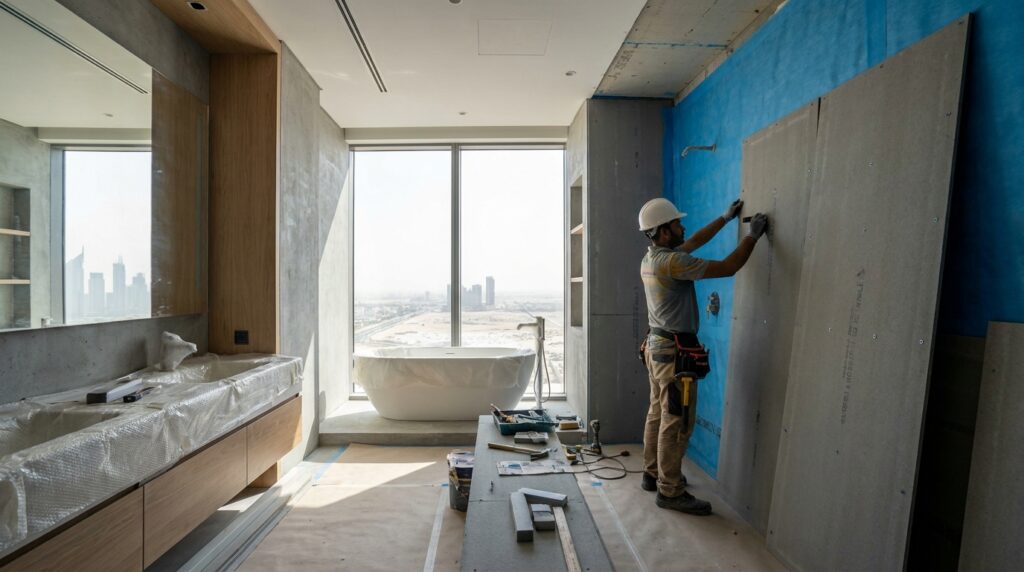
Bathrooms continue to be one of the most frequent uses of cement board for bathrooms UAE. It provides a strong base for the tiles and shields the wall structure from moisture.
Typical bathroom situations include:
- Shower walls
- Bathtub surrounds
- Vanity walls
- Wet room partitions
- Bathroom floors beneath tiles
Cement board behind tiles is also installed by many contractors as it assists in preventing tile movement and eliminates the possibility of damage from moisture behind the wall finish.
Best Installation Practices
To get the best results:
- Select boards 10-12 mm thick for wet wall.
- Install corrosion-resistant screws.
- Allow separation of small spaces between boards.
- Secure joints with an alkali-resisting mesh tape.
- Use a waterproof membrane before tiling.
Fibre cement boards are equally effective for moisture-resistant partition walls. Explore our guide on Fiber Cement Board for Wall Partition Systems in UAE Offices & Homes to learn where FCB provides superior durability, fire resistance, and acoustic performance.
Even though concrete boards are water-resistant, they are not waterproof. Waterproof membranes are still necessary in showers and wet areas that are constantly wet.
Cement Board in Kitchens.
Kitchens experience frequent water sprays, steam, and temperature fluctuations. The cement board for bathrooms UAE installation also works effectively in kitchens, since the same moisture-resistant features help protect the walls.
Common uses in the kitchen involve:
- Tile backsplashes
- Sink areas
- Utility rooms
- Food preparation zones
Cement boarding behind tiles offers a solid surface that supports heavy tiles and minimizes future maintenance.
To provide extra safety on projects, a waterproof backer board UAE solution is also used by many contractors in splash-prone areas around sinks and worktops.
If your project also includes moisture-prone ceiling areas such as bathrooms, kitchens, or exterior soffits, read our guide on Using Fiber Cement Board for False Ceiling: Interior & Exterior UAE to learn why fibre cement boards offer a longer-lasting alternative to traditional gypsum ceilings.
Cement Board for Pool Surrounds
One of the harshest building materials environments is formed by swimming pools. Constant moisture, chlorine exposure, and direct sunlight can damage ordinary wall boards over time.
A cement board for bathrooms UAE also performs well around swimming pools because it offers:
- High moisture resistance
- Consistent performance with temperature variations
- Strong tile support
- Reduced risk of cracking
- Better resistance to mould growth
Lots of architects advise to use cement board behind tiles in the pool areas and around the spas since their core strength does not be weaker even under the hard conditions outside.
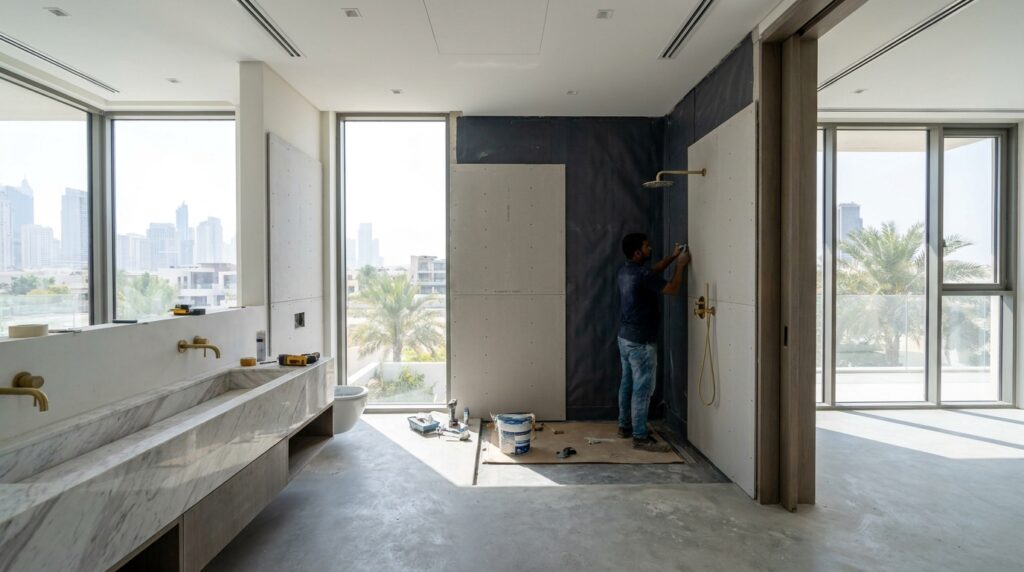
Waterproof backer board UAE product may be used in case the maximum moisture protection is needed. These boards have inbuilt waterproofing, which minimizes the amount of extra waterproofing applied and yet offers great support for tiles.
Selecting the Cement Board to fit your UAE project.
To get sustainable outcomes, the choice of the appropriate board is laid down. The thickness or the type of board needed depends upon the project. Your choice depends upon the location, the amount of moisture, the weight of tiles, and the method of installation.
Here are some factors to be considered before purchasing:
- Board thickness: Bathroom walls and other wet areas use 10-12 mm board thickness. Heavy tiles are supported best by thicker boards.
- Density: High-density fibre cement boards have increased strength, moisture resistance, and impact performance.
- Certifications: Select products that are in accordance with accepted standards like ASTM C1186 and are CE-certified.
- Application: Choose products intended for wet environments, not standard interior wall boards.
- Supplier support: Find an experienced bathroom board supplier Dubai that can advise on the appropriate board to use in your project.
In case you require extra protection against moisture, you may need to apply a waterproof backer board UAE on your shower walls, wet rooms, and other highly moisture areas. These boards minimize water entry and make waterproofing the boards easy during installation.
Looking beyond interior applications? Our guide on Fiber Cement Cladding & Facade Panels for UAE Building Exteriors explains how fibre cement boards provide durable, fire-safe, and weather-resistant solutions for modern building facades across the UAE.
Fiber cement boards are also widely used in prefab and modular buildings where moisture resistance and durability are essential. Learn more in Fiber Cement Board for Prefab & Modular Construction in UAE.
Why Builders Trust Geminite?
The cement board for bathrooms UAE is a consideration of quality. Geminite manufactures fibre cement boards that are designed to perform in the UAE’s demanding climate.
Benefits of choosing Geminite
- Resistance to high moisture and humidity.
- Excellent tile adhesion
- Fire-resistant construction
- Appropriate in bathrooms, kitchens, pool surrounds, and other wet locations.
- Multiple thickness options for different applications
- Reliable technical support
- Relied upon by contractors, architects, and developers in the UAE.
One of the most suitable options in the construction of wet areas is a cement board for bathrooms UAE. It has very good moisture resistance, high tile support, fire resistance, and long durability. It offers a stable foundation, which succeeds in the harsh climate of the UAE, including bathrooms and kitchens, as well as around swimming pools.
While wet areas are one of the most common applications of fibre cement boards, they are also widely used for partitions, ceilings, facades, soffits, and commercial buildings. Explore our guide on Fiber Cement Board Applications: Interior & Exterior Uses in UAE Buildings to discover where fibre cement boards deliver the best performance across residential, commercial, and industrial projects.
In search of high-quality fibre cement boards? Contact Geminite to get the solution to your next residential or commercial project. You can also explore here to learn more about where fibre cement boards are used in modern UAE buildings.
FAQs
- Why are cement board for bathrooms UAE better than drywall?
A cement board for bathrooms UAE is moisture, humidity, and mould-resistant, which is why it is used in wet areas. It does not swell, become soft, or corrode when exposed to water, as compared to drywall, which makes it a strong base for tiles.
- Does cement board behind tiles prevent water damage?
Yes. The installation of cement board behind tiles provides a rigid, stable base that supports the tiles and minimizes the risk of moisture damage. Nevertheless, it must always be used with a waterproof cover in showers and other wet areas.
- Is a waterproof backer board UAE better than a standard cement board?
A waterproof backer board UAE is already equipped with waterproof properties, eliminating the need to apply more waterproofing to the surface. It is a good option in showers, wet rooms, spas and swimming pools where there is constant exposure to moisture.
- What thickness of cement board is recommended for bathrooms?
For most residential and commercial bathrooms in the UAE, 10–12 mm fibre cement boards are recommended. The thickness offers great stability to ceramic, porcelain, and natural stone tiles.
- Can cement boards be applied in a kitchen?
Yes. The cement boards are commonly utilized in the backsplash, sink, and other parts of the kitchen where moisture exposure occurs. The use of cement board behind the tiles is aimed at enhancing the adhesion capacity of tiles, besides safeguarding the wall against water.
- Are cement boards suitable for pool surrounds?
Absolutely. Cement boards make good pool surrounds since they do not suffer humidity and exposure to chlorine as well as change of temperature. They offer a long-lasting surface to outdoor tiles and other finishes.
- How can I select a proven bathroom board supplier Dubai?
Select a bathroom board supplier Dubai that can provide certified fibre cement boards, technical advice, a steady supply of the products, and one that adheres to established quality norms, including ASTM and CE certifications.
- Does a cement board bathrooms UAE need waterproofing?
Yes. A cement board used in bathrooms in the UAE is quite moisture-resistant but not entirely waterproof. It is also advisable to apply an approved waterproof membrane before tiling to ensure maximum protection.
- How does the installation of a cement board take place?
A quality cement board installation will last for decades when properly waterproofed. It needs minimal maintenance and still offers high levels of support to tiles during its service period.
- Why use Geminite to make fibre cement boards in the UAE?
Geminite provides high-quality fibre cement boards suitable for the climate of the UAE. Their products have good moisture resistance, fire resistance, tile adhesion, and longevity in bathrooms, kitchens, pool surrounds, and other wet areas.
At a Glance