

- New
- July 14, 2026
Fiber Cement Board for Wall Partition Systems in UAE Offices & Homes
Most people do not think hard about partition walls. They go up. Rooms appear. Job done.
Then the complaints start. Noise bleeds between offices. A bathroom wall softens after a year. A partition dents when someone moves furniture. That is when the material choice becomes obvious.
Fiber cement wall partition UAE buildings use is gaining ground over gypsum in specific applications. Not everywhere. But where it matters, FCB outperforms alternatives that look similar on paper and fail differently on site.
This guide covers where FCB partitions work, how they are built, and what to watch for in office and home applications across the UAE.
At a Glance
What Makes FCB Different as a Partition Board
Standard gypsum board is a soft mineral core between two paper sheets. It is light, fast to install, and affordable. It also dents under impact, softens in moisture, and burns.
Fiber cement board is cement, sand, and cellulose fiber pressed into a dense sheet. No paper facing. No soft core. It takes impact without denting. It handles moisture without swelling. It does not burn.
These are not minor differences. In the wrong environment, gypsum fails. In the right environment, it works fine at a lower cost. Knowing which environment you are building in is the whole decision.
Besides interior partitions, fiber cement boards are an excellent choice for exterior building facades. Learn more in our guide Fiber Cement Cladding & Facade Panels for UAE Building Exteriors, covering weather resistance, facade installation, and UAE compliance requirements.
Interior Partition Board UAE Buildings: Where FCB Is the Right Call
Wet area partitions. Bathrooms, utility rooms, laundry areas. These are the clearest cases. A gypsum partition wall in a wet area absorbs moisture through tile grout lines, failed sealant, and steam over time. The board softens. Tiles start to shift. FCB does not absorb moisture. It holds its shape. It is the correct interior partition board for UAE buildings with wet area walls.
The same moisture-resistant properties also make FCB an excellent choice for suspended ceilings. Learn more in our guide on Using Fiber Cement Board for False Ceiling: Interior & Exterior UAE.
High-traffic corridors. Office buildings, hotels, hospitals, residential towers. Corridors take daily impact from trolleys, bags, furniture moves, and maintenance access. Gypsum board shows it. FCB does not. The surface stays intact under the kind of contact that normal building use creates.
Pantry and kitchen partitions. Commercial pantries and residential kitchens generate steam and grease and require regular cleaning with water. Gypsum in these spaces degrades faster than in a dry office. FCB handles the conditions without extra waterproofing treatment.
Plant rooms and service areas. Access is frequent. Humidity from mechanical equipment is constant. Standard gypsum is a poor choice. FCB holds up without special treatment.
For a deeper look at fibre cement boards in moisture-prone spaces, explore our guide on Cement Board for Wet Areas: Bathrooms, Kitchens & Pool Surrounds in UAE, which covers best practices for bathrooms, kitchens, and other wet environments.
Lightweight Wall Partition Abu Dhabi: Office Applications
Abu Dhabi office construction has specific demands. Dubai Civil Defence and Abu Dhabi building codes require fire ratings for partitions in escape routes, stairwells, corridors, and plant rooms. The minimum is typically 30 minutes, rising to 60 or 120 minutes in high-rise or critical areas.
FCB partition systems can be specified and tested to meet these fire ratings. The board itself is non-combustible. When combined with the right stud frame and cavity configuration, the assembly achieves the required rating for compliance.
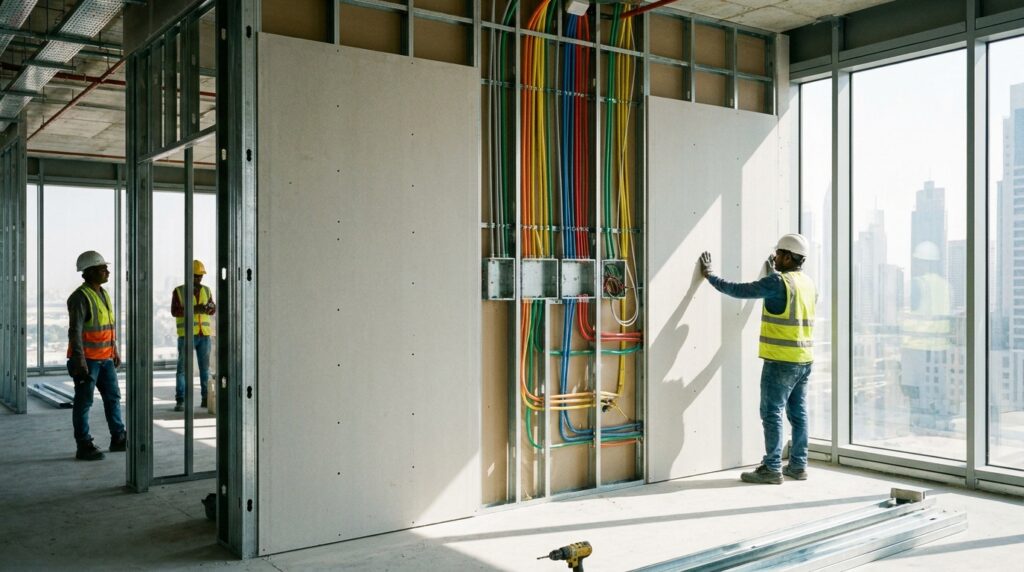
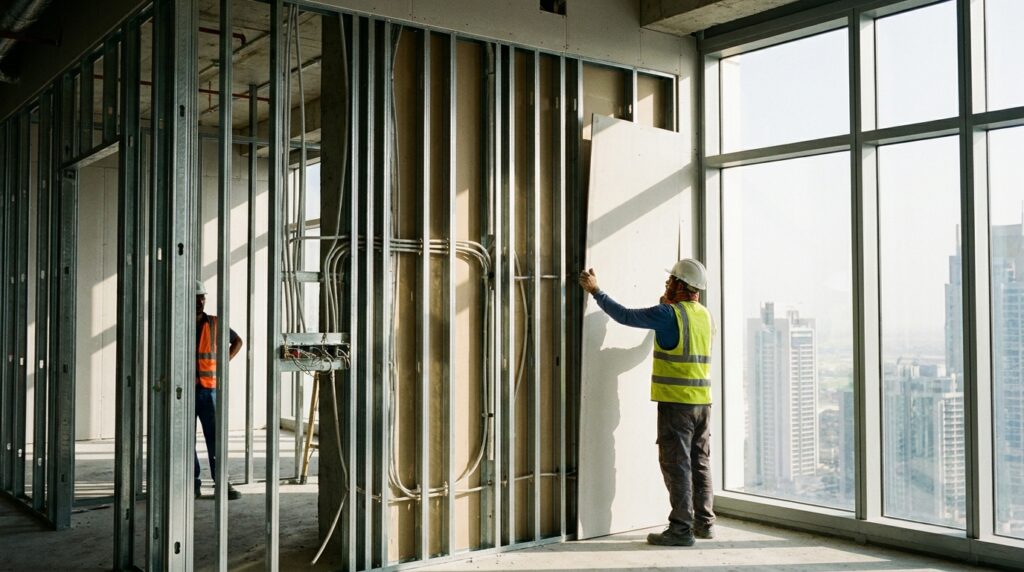
For lightweight wall partition Abu Dhabi developers and fit-out teams need on tight programs, FCB stud systems offer a fast, dry installation method. No plaster. No mortar. No curing time. Metal studs go up, boards are fixed to both faces, joints are finished, and the wall is ready for paint or tile the same day.
Speed matters on commercial office fit-outs in Abu Dhabi. A partition system that removes plastering and curing from the program saves days on a single floor and weeks across a full office tower.
FCB Partition Wall: Acoustic Performance
This is where a lot of questions come in. Does FCB provide good sound insulation between rooms?
The honest answer: the board is part of the system, not the whole system.
Sound insulation in a stud partition comes from four things working together. The board mass. The cavity depth. The insulation inside the cavity. The way the frame is detailed at junctions.
A standard office STC rating in the UAE sits between 45 and 55. That is enough to prevent normal conversation from carrying clearly between rooms. Higher ratings, above 55, are used for boardrooms, HR offices, legal rooms, and anywhere speech privacy is non-negotiable.
FCB is denser than standard gypsum. More mass in a partition board generally improves sound performance. But an FCB wall with no cavity insulation will underperform a well-specified gypsum wall with proper acoustic insulation inside the frame.
The right approach: specify the whole system. Board type, stud spacing, cavity depth, and insulation specification all need to work together to hit the target STC rating. FCB gives you a stronger starting point on mass. Cavity insulation does the rest.
Homes: Where FCB Partition Walls Make Sense
Most residential partitions in UAE villas and apartments are dry interior walls. Bedrooms, living rooms, dining areas. These do not need FCB. Gypsum board is the right call. It costs less and does the same job.
FCB earns its place in residential settings in specific rooms.
Bathroom and wet room walls. Any partition that forms a shower, bath, or wet room boundary. FCB is the correct specification. Full stop.
Kitchen partition walls. Walls behind cooking areas, near sinks, and adjacent to dishwashers. Moisture exposure is real and regular. FCB handles it.
Ground floor partitions near external walls. In some UAE villa designs, ground-floor partitions sit close to external walls that experience higher ambient moisture from the ground. FCB in these locations reduces the risk of moisture migration affecting the partition over time.
Children’s rooms and high-use spaces. Impact resistance matters here. FCB takes knocks, furniture contact, and general wear without denting or cracking the way gypsum does.
How an FCB Partition Wall Is Built
The construction sequence is straightforward. Understanding it helps with coordination on site.
Steel track to floor and ceiling. Galvanized steel track fixes to the floor slab and ceiling slab. This forms the top and bottom of the partition frame.
Vertical steel studs. Studs fit inside the track at regular centres. 400mm or 600mm centres depending on the specification and the load requirements. Closer stud spacing increases rigidity and adds to acoustic performance.
Services in the cavity. Electrical conduit, data cabling, and any other services run inside the cavity before the boards go on. This is the time to coordinate with MEP. Once boards are fixed, cavity access is gone.
FCB boards fixed to both faces. Boards are fixed to the studs with corrosion-resistant screws. Pre-drill near edges to prevent cracking. The dense composition of FCB needs the right drill bit and screw type. Standard gypsum fixings are not always the right specification for FCB.
Cavity insulation. Mineral wool or acoustic insulation fills the cavity before the second face is boarded. This is where the acoustic performance is built into the wall.
Joint treatment. Alkali-resistant mesh tape and a compatible jointing compound. Gypsum-based jointing products may not bond correctly to FCB. Verify compatibility with the board manufacturer before applying.
Prime before paint. FCB is alkaline. A cement primer seals the surface before any paint coat. Skip this step, and the paint will peel.
Common Mistakes in FCB Partition Installation
Using standard gypsum screws. They are not always the right length or thread for FCB density. Check the fixing specification.
Skipping cavity insulation. The wall goes up fast and looks fine. The acoustic complaints start after handover.
Not coordinating services before boarding. Opening up an FCB partition after the fact costs time and money. Get the MEP in the cavity before the second face goes on.
Using gypsum jointing compound on FCB. It does not always bond correctly. Use the manufacturer-recommended product.
No primer before paint. The finish looks fine for a few months. Then it peels.
Fiber cement partition systems are also widely used in prefab and modular construction because they enable faster installation while maintaining structural performance. Read Fiber Cement Board for Prefab & Modular Construction in UAE.
Conclusion
Fiber cement wall partition UAE offices and homes need is not a universal replacement for gypsum. It is a material with specific strengths: moisture resistance, impact resistance, non-combustibility, and density that supports acoustic performance.
Getting the specification right at the start means fewer problems after handover and a wall that performs for the life of the building.
Partition walls are just one of many uses for FCB. Explore our guide on Fiber Cement Board Applications: Interior & Exterior Uses in UAE Buildings to see where it is used for ceilings, facades, cladding, wet areas, and commercial projects.
To discuss fiber cement partition boards for your next project, contact Geminite using this contact form.
Frequently Asked Questions
What is a fiber cement wall partition in UAE construction?
It is a stud-framed partition system using FCB panels instead of gypsum, suited for wet areas, high-traffic spaces, and fire-rated applications.
Is FCB better than gypsum for office partitions in the UAE?
In wet areas, corridors, and fire-rated zones, yes. In standard dry office partitions, gypsum performs well at a lower cost.
What is the standard fire rating for office partitions in the UAE?
Dubai Civil Defence requires a minimum of 30 minutes for most partitions, rising to 60 or 120 minutes in escape routes, stairwells, and high-rise buildings.
Does an FCB partition wall provide good sound insulation?
Yes, when properly specified. FCB density improves mass, but acoustic performance also depends on cavity insulation, stud spacing, and junction detailing.
What STC rating do UAE office partitions typically need?
Standard office spaces target STC 45 to 55. Boardrooms, HR, and legal areas typically require higher ratings above 55.
Why is FCB recommended for lightweight wall partition Abu Dhabi projects?
It installs dry with no plastering or curing, reduces program time, and meets fire and moisture requirements in commercial applications.
What fixings should be used for an interior partition board UAE installation?
Corrosion-resistant galvanized screws of the correct length and thread for FCB density. Standard gypsum screws are not always the right specification.
Should cavity insulation be used in an FCB partition wall?
Yes. Mineral wool or acoustic insulation in the cavity is what delivers the wall’s acoustic performance alongside the board mass.
Can fiber cement wall partitions be used in UAE residential villas?
Yes, in bathrooms, kitchens, and high-use rooms. Standard dry interior rooms are better served by gypsum at a lower cost.
What primer should be used before painting an FCB partition wall?
A cement-specific alkali-resistant primer is needed before any paint coat. Skipping this step causes paint adhesion failure within months.
At a Glance