

- New
- July 13, 2026
Using Fiber Cement Board for False Ceiling: Interior & Exterior UAE
Most people default to gypsum for false ceilings. It is cheap, light, and easy to install. But gypsum has limits. Put it in a bathroom. Leave it exposed on a balcony soffit. It starts to fail. That is where fiber cement board false ceiling UAE projects are gaining ground, and for good reason.
This guide covers when FCB is the right ceiling material, how it installs, and where it outperforms every other option on the UAE market.
While this guide focuses specifically on false ceiling applications, our Fiber Cement Board Applications: Interior & Exterior Uses in UAE Buildings article explores how the same material is used for partitions, facades, cladding, soffits, and other construction applications across the UAE.
At a Glance
Why Ceiling Material Matters in the UAE
The UAE climate does not treat building materials gently. Temperatures swing hard between day and night. Coastal humidity sits high from June through September. AC units run constantly, cycling moisture through ceiling cavities. A ceiling board that cannot handle these conditions will sag, crack, or grow mold. Sometimes all three.
False ceilings also hide services. Wiring, ducts, drainage, and fire suppression pipes. They get accessed. They get knocked. They need to hold up under routine maintenance, not just during installation
What Is a Fiber Cement Board False Ceiling?
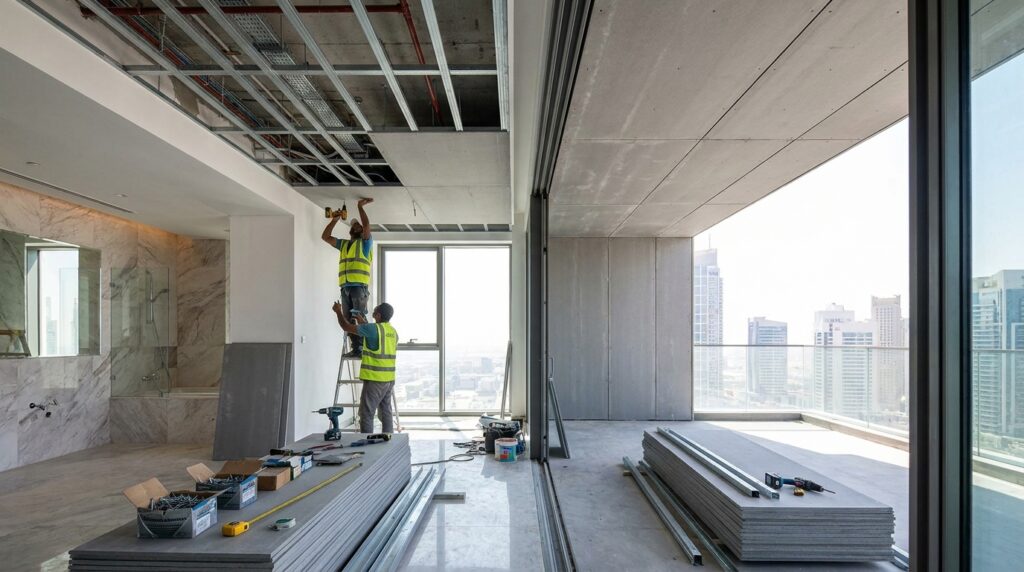
It is a suspended ceiling system that uses FCB panels instead of gypsum. The boards are fixed to a metal grid suspended from the structural slab above. Joints are taped and finished. The surface gets painted or tiled.
Same installation principle as gypsum. Different board entirely.
FCB is cement, sand, and cellulose fiber pressed into flat sheets. No paper facing. No gypsum core. Nothing that absorbs water or burns.
Interior Applications: Where FCB Ceilings Make Sense
Bathrooms and wet rooms. This is the clearest case. Gypsum board in a bathroom ceiling absorbs steam over time. The core softens. Joints bubble. The ceiling sags. Fiber cement board does not absorb steam. It does not sag. It is the standard specification for any bathroom false ceiling that will last. If your project also includes moisture-resistant partition walls, read our guide on Fiber Cement Board for Wall Partition Systems in UAE Offices & Homes to learn where FCB outperforms gypsum in interior wall systems.
When selecting materials for wet environments, it’s equally important to choose the right wall substrate. Read our guide on Cement Board for Wet Areas: Bathrooms, Kitchens & Pool Surrounds in UAE to learn why fibre cement boards are the preferred choice for bathrooms, kitchens, and pool surrounds.
Kitchens. Heat, grease, and cleaning cycles hit kitchen ceilings hard. FCB handles all three without breaking down.
Hotel and hospital corridors. High foot traffic means ceiling access panels open and close constantly. FCB takes that physical contact without denting or chipping the way gypsum does.
Commercial spaces with high occupancy. Restaurants, gyms, retail fit-outs. Spaces that get hot, humid, and busy. FCB holds its shape where gypsum starts to show wear.
Ground floor ceilings above car parks. Moisture rises from below. Exhaust fumes sit in the air. Gypsum degrades in this environment. FCB does not.
Exterior Applications: Where Only FCB Works
This is the most misunderstood part of the false ceiling conversation in UAE construction.
Gypsum board cannot go outside. Not even moisture-resistant gypsum. It is not rated for outdoor exposure. Wind-driven rain, UV, and the extreme temperature swings of a UAE exterior will destroy a gypsum ceiling board.
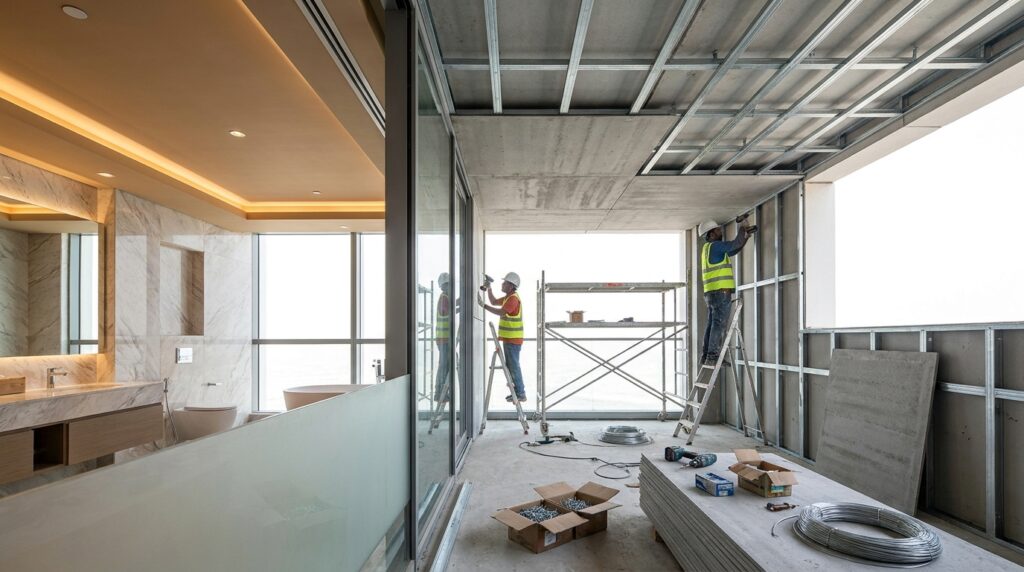
FCB is built for this. Exterior soffits, covered car porches, balcony ceilings, pergola undersides, and facade overhangs all need a board that handles direct weather exposure. FCB is dimensionally stable under thermal cycling. It does not absorb rain. UV does not break it down.
For any ceiling that faces the outside, FCB is not a preference. It is the correct specification.
Fiber cement boards are also widely used for durable exterior wall cladding. Explore our blog Fiber Cement Cladding & Facade Panels for UAE Building Exteriors to understand how FCB performs in UAE facade systems and meets fire safety requirements.
Cement Board Ceiling Tiles UAE: Panel Sizes and Options
Cement board ceiling tiles UAE suppliers and manufacturers typically offer them in standard sheet sizes: 1200x2400mm and 1220x2440mm. Thicknesses for ceiling applications generally range from 6mm to 12mm.
Thinner boards suit lightweight suspended ceiling grids. Thicker boards are used where impact resistance matters, such as ceilings above vehicle access or plant rooms.
Surface finishes vary. Smooth face for painted applications. Textured face for specific architectural finishes. Some boards are pre-pigmented, reducing the need for additional paint coats.
Always verify the board’s density rating and moisture resistance classification on the product data sheet before specifying for wet or exterior applications.
False Ceiling Material Dubai: FCB vs Gypsum at a Glance
Gypsum board costs less per square meter. It is lighter and easier to handle. For dry interior ceilings in bedrooms, living rooms, and offices, it is a practical choice and the correct specification.
FCB costs more per sheet. It is heavier. It takes more skill to cut and fix cleanly. But in a bathroom, kitchen, exterior soffit, or any space where moisture or impact is a real factor, gypsum will fail before FCB even shows signs of wear.
The false ceiling material Dubai procurement teams choose should reflect the conditions of the space, not just the material price. The wrong board in a wet or outdoor ceiling costs far more in rework than the price difference ever saves upfront.
FCB Ceiling Installation Guide: Key Steps on Site
The installation process follows the same basic sequence as gypsum, with a few important differences.
Step 1: Frame the ceiling grid. Metal furring channels or a proprietary suspension system are fixed to the structural slab using hanger rods. The grid is leveled before any board goes up.
Step 2: Pre-drill the boards. FCB is dense. Driving fixings without pilot holes cracks the board near the edges. Pre-drilling is not optional on-site. It is a standard step that saves boards and time.
Step 3: Fix boards to the grid. Corrosion-resistant screws are the correct fixing for FCB. Standard steel screws rust in humid conditions. Use the right fastener from the start.
Step 4: Leave expansion gaps. FCB expands slightly with moisture and temperature. A 2mm gap at board edges prevents buckling over time. Fill the gaps with a flexible sealant, not a rigid filler.
Step 5: Tape and finish joints. Use alkali-resistant mesh tape and a compatible jointing compound. Standard gypsum jointing products may not bond correctly to FCB. Check product compatibility before applying.
Step 6: Prime before painting. FCB is alkaline. A cement-specific primer seals the surface and prevents paint adhesion failures. Skipping this step shows in the finish.
Common Mistakes to Avoid
- Using gypsum jointing compound on FCB joints. It fails. Get the right product.
- Skipping primer. Paint peels within months on unprimed FCB.
- Using ungalvanized screws in wet areas or exterior ceilings. They rust, stain the board, and eventually pull through.
- Fixing boards without pre-drilling. Edge cracking is almost guaranteed on a dense FCB sheet without pilot holes.
- Ignoring expansion gaps. Boards buckle in the UAE heat cycles when they are fixed tightly with no room to move.
Besides false ceilings, fiber cement boards are extensively used in prefab and modular buildings for walls, ceilings, and structural lining systems. Read Fiber Cement Board for Prefab & Modular Construction in UAE to learn more.
Conclusion
Fiber cement board false ceiling UAE applications cover a wide range. Wet rooms, kitchens, commercial interiors, and every exterior soffit in the country. Gypsum works well where it belongs: dry interior spaces with no moisture or impact exposure.
Outside of those conditions, FCB is the stronger, longer-lasting specification. The installation process is straightforward when the right tools, fixings, and finishing products are used from the start.
To source fiber cement boards for ceiling applications in the UAE, contact Geminite at this contact form.
Frequently Asked Questions
Can fiber cement board be used for false ceilings in UAE bathrooms?
Yes, it is the recommended specification for bathroom ceilings because it resists moisture without sagging or cracking.
What is the difference between FCB and gypsum for false ceiling material in Dubai?
Gypsum suits dry interior ceilings; FCB handles moisture, impact, and outdoor exposure that gypsum cannot.
Is fiber cement board suitable for exterior soffits in the UAE?
Yes, it is the correct board for any ceiling exposed to outdoor conditions, including balconies, car porches, and facade overhangs.
What thickness of cement board ceiling tiles do UAE projects typically use?
6mm to 12mm, depending on the application. Thinner boards suit standard suspended grids; thicker boards handle heavier-use areas.
What fixings should be used for FCB ceiling installation?
Corrosion-resistant or galvanized screws only. Standard steel screws rust in humid conditions and stain the board.
Does fiber cement board need to be primed before painting?
Yes. FCB is alkaline and requires a cement-specific primer before paint, or the topcoat will peel.
How does FCB ceiling installation differ from gypsum?
FCB requires pre-drilled holes, corrosion-resistant fixings, alkali-resistant joint tape, and expansion gaps that gypsum ceiling systems do not always need.
Can gypsum board be used for exterior ceilings in Dubai?
No. Gypsum is not rated for outdoor exposure and will deteriorate under UAE weather conditions regardless of whether moisture-resistant variants are used.
What is the standard panel size for fiber cement board false ceilings?
Most FCB sheets for ceiling use come in 1200x2400mm or 1220x2440mm, available in thicknesses from 6mm upward.
How does a fiber cement board false ceiling in the UAE compare to PVC ceiling panels?
FCB handles higher temperatures, takes paint and tile finishes directly, and performs better in fire-rated ceiling assemblies than PVC panels.
At a Glance