

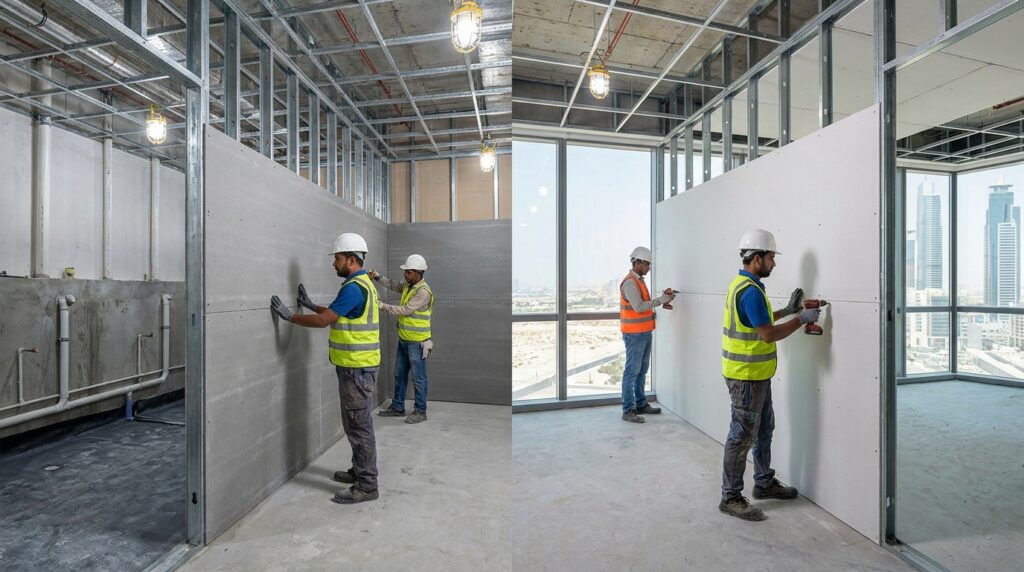
- New
- June 25, 2026
Cement Board vs Drywall for Commercial Projects in UAE
A wall that fails in the UAE’s heat does not just crack. It swells, stains, and, within months, transforms into an unanticipated repair cost. This is exactly what the “cement board vs drywall UAE” error entails and what it looks like on business sites throughout the year. The question at the center: is drywall waterproof UAE or is it just fine till the time of leakage?
A lot of business proprietors choose a wall material only considering its price. Then they witness that “saving” is lost as they see the molds knocked off and the new panels installed before the first year goes by. We have been working on commercial projects on a daily basis at Geminite, and we have witnessed the lifespan of walls in the UAE’s climate. Here, you will get to know the abilities of each material, the areas where they can be applied best, and which one can save hard cash.
At a Glance
What is Cement Board, and What is Drywall?
Cement board and drywall may appear to be the same product on the job site, but they’re actually quite different. If you can understand the content of each one, then you will better understand their differences in action after they are installed.
Drywall is made from gypsum, pressed between two sheets of paper. It is light, easy to cut, and quick to put up, which is why you see it in dry offices and shop interiors.
Geminite’s Fiber cement Boards are constructed with this mix and are infused with cellulose fiber and silica sand for added strength. As there is no paper to drink up or provide nourishment for water and mold, the cement board is able to stand up to the heat and humidity of the UAE. This simple difference in materials is the starting point for the whole cement board vs drywall UAE comparison.
Cement Board vs Drywall: Side-by-Side Comparison
A quick side-by-side view makes the cement board vs drywall UAE choice much easier. The table below lines up both materials across the things that matter most on a commercial site in the UAE.
Feature | Drywall | Cement Board |
Core material | Gypsum with paper facing | Cement and fiber, no paper |
Moisture resistance | Poor; absorbs water and swells | Strong; resists water without swelling |
Mold and mildew resistance | Low, especially once paper gets wet | High; no organic food source for mold |
Fire resistance | Needs chemical treatment for a fire rating | Naturally non-combustible |
Impact and durability | Light, prone to dents and holes | Dense and impact-resistant |
Termite and insect resistance | Not resistant | Termite and insect proof |
Typical UAE use case | Dry offices, retail partitions | Wet areas, facades, high-traffic zones |
Upfront cost | Lower | Higher |
Long-term cost | Higher, due to repairs and replacement | Lower, due to longer lifespan |
Is Drywall Waterproof in UAE Conditions?
One of the most frequent questions asked by the commercial buyer before the commencement of fit-out is “Is drywall waterproof UAE?” Unfortunately, the answer is no – standard drywall is not waterproof, and treated versions of the material only help to slow damage down.
The UAE’s construction sector is on track for steady growth through 2026, which means more commercial buildings will face this same heat and humidity exposure every year
UAE summers tend to be humid, with an accompanying rush of humidity into the house from cooling systems. As the number of commercial buildings rises throughout the country, this exposure will keep increasing. Cement board, however, was made for water. It doesn’t cause any swelling, softening, or weakening, which makes it the better option for most contractors in the UAE.
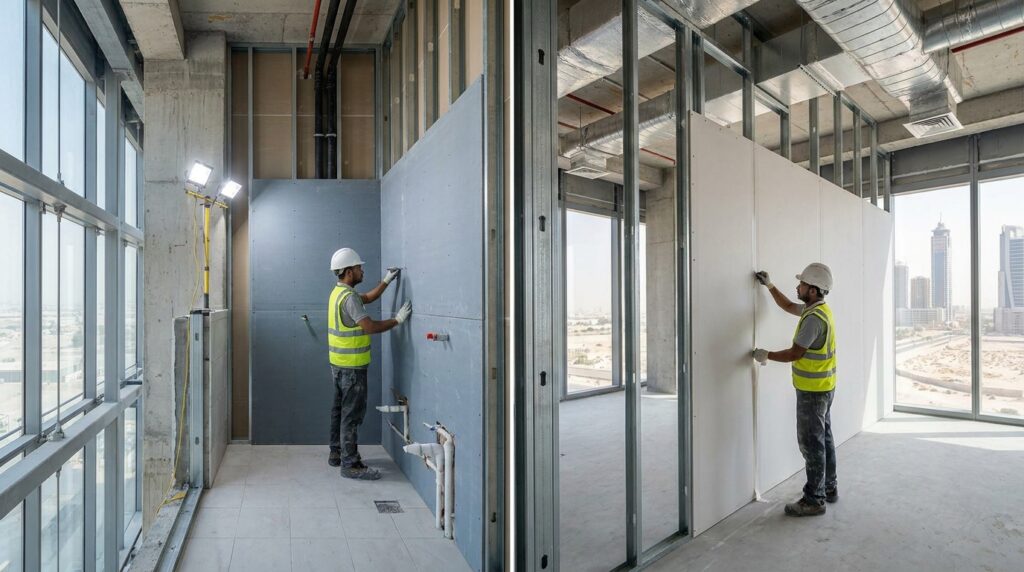
Drywall vs Cement Board Wet Areas UAE
These two materials don’t blend very well in wet areas and can be a major factor in any project you consider doing when it comes to using cement board vs drywall UAE. Just before starting to decorate your kitchen or spa, you should ask yourself, “is drywall waterproof UAE conditions allow?” and imagine steam, splashes, and standing water as normal, and not a problem.
Because drywall behind wet areas is organic, mold can grow within months in these areas and on the surface of the drywall in the form of mold from the paper on the drywall and behind it in the corresponding space.
In those spots, materials get tested every single day. See how each one would fare at this level of pressure.
- Spaces or areas that do see a lot of water, such as attics, can have mold developing behind the drywall within months after exposure, as the paper face supplies the environment for mold to grow.
- Cement board has no organic matter for fungus to feed on, is not harmed by mold and mildew, and remains firm and flat when in direct contact with water every day.
- Fixing water-damaged drywall again and again adds up fast, while cement board’s higher starting cost is usually a one-time cost.
Whatever happens in wet areas UAE, cement board is the winner when compared to any drywall vs cement board wet areas UAE. Read more in our guide on waterproof fiber cement boards for bathrooms and kitchens, which goes deeper into how this plays out in real UAE buildings.
Benefits of Choosing Cement Board for Commercial Projects
While the main advantage of using cement board is waterproofing, there are several tangible benefits. It’s these benefits that make it the preferred choice of the commercial drywall alternative UAE for challenging projects.
Unlike traditional drywall, which can deteriorate in high humidity and temperatures, Cement Board can withstand the climate in UAE while remaining strong in the long term. It also requires significantly less maintenance and support, resulting in reduced maintenance costs during the building’s lifespan, as well as reduced repair callouts.
- It contributes to the use of eco-friendly raw materials in many cement board products, which helps the green building objectives.
- It is resistant to termites and insects – relevant for ground units and warehouses where there are landscaped areas.
- It makes use of the outside and inside, the partitions, on the exterior of the building.
If your project includes any wet area, busy zone, or fire-sensitive space, cement board is the stronger commercial drywall alternative UAE projects can count on for the long run.
Fire Safety and Strength in High-Traffic Spaces
There are tough fire codes for UAE commercial buildings, and the type of wall you use can have an effect on adhering to those codes. In the cement board vs drywall UAE comparison, fire safety is one area where the gap comes from how each material is made, not from something added later.
Adding chemicals to standard drywall is possible, but it can degrade over time, particularly in high heat environments, and will only make the drywall fire-rated. Fire resistance is inherent in cement board: cement does not burn, and therefore the fire resistance of the cement board is built-in. Read our guide to cement board regulations and standards in the UAE for more information.
Strength is equally important in the hectic business environment. Drywall is light, but you can also feel the weak side of it; if a trolley or a cart is accidentally knocked against it, drywall will leave dents or holes. Cement board is dense and strong and is designed to withstand the regular wear and tear of a floor found in a school, a warehouse, or a mall.
Cost Comparison: Upfront Price vs Long-Term Value
Budget is always part of this choice, so let’s be direct about where each material wins in the cement board vs drywall UAE cost comparison. Initially, drywall costs are lower, as it’s lightweight, can be installed rapidly, and is accessible all over the UAE.
As construction continues to grow on track through 2030, builders are increasingly turning to materials that will save them money over the long term – as well as on day one.
Although the initial cost may be a little higher, cement board repels the need for additional repairs, maintenance, and fire treatments, which can make it a cost-effective choice. In the coming years, with more commercial and residential projects going under the construction phase, more developers are choosing materials for their construction that help in reducing the total cost of the project, not only the initial price tag.
The drywall buyer can win the first time when the initial payment is made, but cement board will likely prevail in terms of cost in the long run. See why Geminite is trusted by commercial projects across the UAE that want this kind of long-term value.
If you’re also evaluating wood-based alternatives, our Fiber Cement Board vs Plywood: Cost, Strength & Durability in UAE Climate guide compares cost, moisture resistance, strength, and long-term performance in UAE conditions.
If your project also involves masonry partition walls, see our Fiber Cement Board vs AAC Blocks UAE comparison for insights into structural load, fire resistance, moisture performance, and installation methods.
If you’re evaluating fiber cement board against traditional brick and block walls, our Is Fiber Cement Board Cheaper Than Traditional Masonry in UAE? guide explains which system offers better long-term value across labor, maintenance, and lifecycle costs.
Commercial Drywall Alternative UAE: Where Cement Board Fits Best
It is not required to have the same material in each wall on a commercial building; some use more than one material and apply them where they are most suited to the structural and functional requirements. Understanding their respective applications controls costs while maintaining safety and strength.
If the walls are going to be subjected to limited use, light, or occur in areas where there is no water, or if the area is lighted with fluorescent lights, drywall is an appropriate material for an office partition. Before you decide on one material over another, you should consider the following differences: Cement board is a superior option for restrooms, kitchens, pantries, spas, pools, facades, interior storefront spaces, and mezzanine flooring.
The decision of cement board or drywall in UAE depends on the location of the wall and its intended usage. Cement board is engineered for the kitchen, restroom, facade, and the hustle and bustle of business districts, and designed for the UAE’s climate.
Would you like to find a material that will last? Explore Geminite’s range of fiber cement boards made right here in the UAE, or get in touch with our team for guidance on your next commercial project.
For a broader comparison with gypsum board, plywood, AAC blocks, and traditional masonry, explore our Fiber Cement Board vs Other Building Materials: A UAE Comparison guide before choosing the right material for your project.
For a detailed comparison between fiber cement board and one of the UAE’s most widely used lightweight masonry materials, explore our Fiber Cement Board vs AAC Blocks UAE guide to determine the right partition solution for your project.
FAQs
1. Is cement board better than drywall for commercial projects in UAE?
Yes in most comparisons of cement board vs drywall UAE. Adopting cement board will enhance the waterproofing, fire resistance, and impact resistance properties of the material, which fits the UAE climate and hectic business environment.
2. Is drywall waterproof in UAE?
No, but in UAE conditions, drywall is not waterproof, hence the question before a wet area fit-out. Even moisture-resistant types will not deter water damage.
3. What is the best commercial drywall alternative in UAE?
Cement board is widely seen as the top commercial drywall alternative UAE buyers choose, especially for wet, busy, or fire-sensitive areas.
4. Is it permissible to use drywall in the bathroom or kitchen of the UAE?
That’s not a good idea. Damp areas, even when the walls are made with mold-resistant drywall, can develop mold and cause damage over time. There, cement board is the safer option.
5. Is cement board more expensive than drywall?
Yes, it’s typically more expensive to start, but that’s about it. However, over time, cement board will save money by requiring fewer repairs and maintenance.
6. Is cement board fireproof?
Yes. Unlike drywall, cement board will not burn and must not be treated with additional chemicals for fire rating.
7. How long does cement board last in UAE’s climate?
Cement board is designed to resist heat and humidity, and with proper usage, will last a much longer period of time than any other drywall, if in the same conditions.
8. Can both drywall and cement board be used in the same commercial building?
Yes. Drywall in dry areas, low traffic, cement board in wet areas, and facades and busy areas are used in many UAE projects.
9. Is cement board heavier than drywall?
Yes! Cement Board is heavier and denser. This contributes to its strength, but should be considered in the design of the building itself.
10. In a commercial building, where should cement board be used?
Cement board is ideal for restrooms, kitchens, spa areas, facades, mezzanine floors, and anywhere that has frequent water exposure or high foot traffic.
At a Glance