

- New
- June 23, 2026
Fiber Cement Board vs Other Building Materials: A UAE Comparison
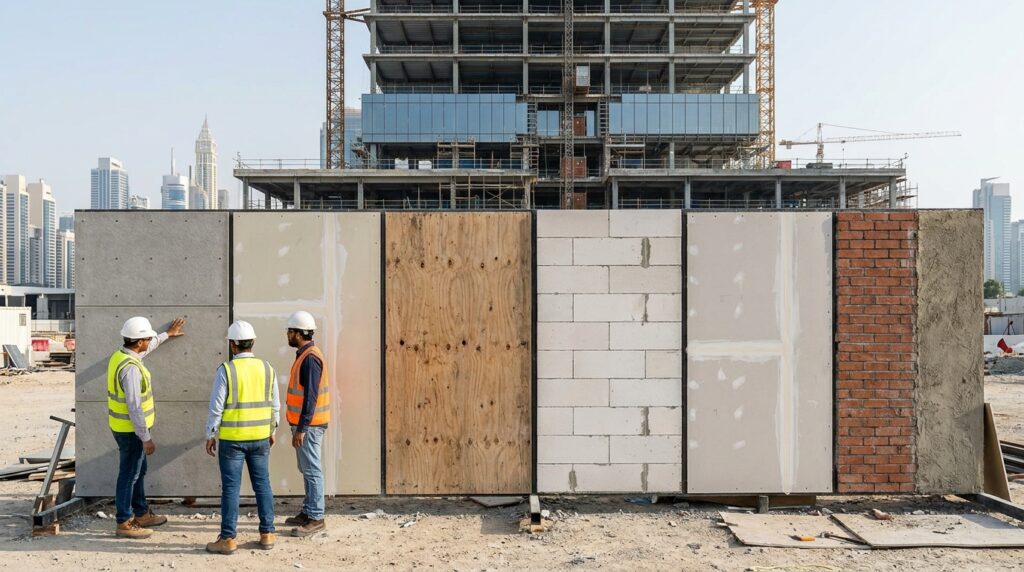
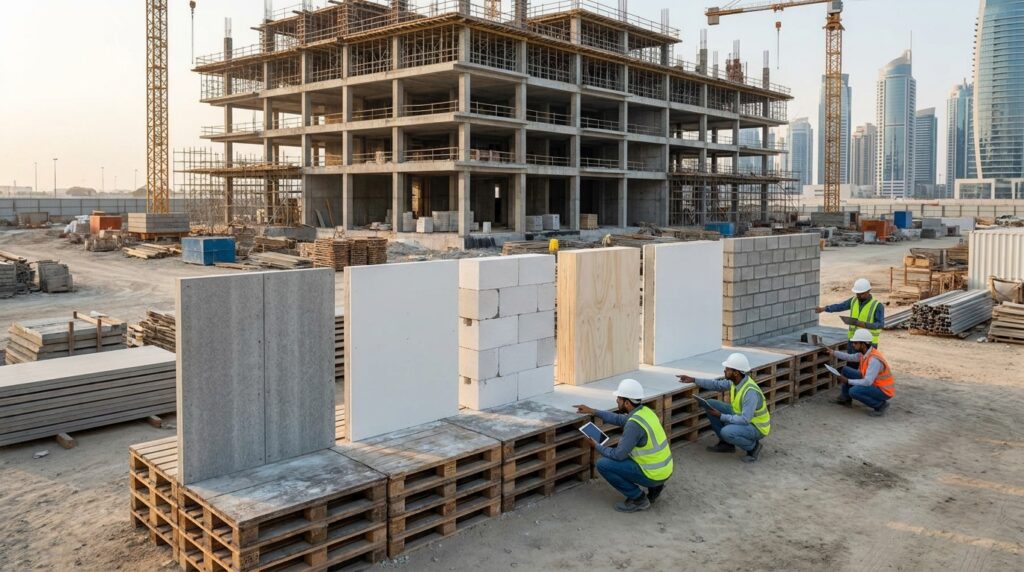
When you are managing a build in the UAE, the wall and ceiling material you choose affects cost, construction time, maintenance, and how long the building holds up. The options that come up most often are fiber cement board, gypsum board, plywood, AAC blocks, drywall, and traditional masonry. Each one works well in specific situations and poorly in others.
This guide gives you a clear comparison across all of them so you can match the right material to the right application before the project starts.
At a Glance
Why Material Choice Matters More in the UAE
Heat, humidity, dust, and coastal air all put pressure on building materials here. A board that performs fine in a mild climate can swell, crack, or break down far sooner in UAE conditions. This is why the fiber cement board vs gypsum UAE question is not just about price. It is about which material will still be doing its job years from now without constant repair.
Getting this decision right at the specification stage saves money on maintenance, avoids rework, and keeps the building compliant with local construction codes.
If you are new to fiber cement boards, start with our Complete Guide to Fiber Cement Boards in UAE, which covers board types, applications, installation methods, and key benefits for UAE construction projects.
What Each Material Is Made Of
Before comparing performance, it helps to know what you are actually working with.
Fiber cement board is made from cement, sand, and cellulose fiber pressed into flat sheets. It is dense, non-combustible, and built to handle water, heat, impact, and outdoor exposure.
Gypsum board, also called drywall, is a soft mineral core pressed between two sheets of paper. It is lightweight, smooth, and easy to install in dry interior spaces.
Plywood is made from thin layers of wood glued together. It is easy to cut and fasten, but it is vulnerable to moisture, heat, and pests over time.
AAC blocks, or autoclaved aerated concrete blocks, are lightweight precast blocks made from sand, cement, lime, and a foaming agent. They are used primarily for wall partitions and load-bearing walls.
Traditional masonry refers to brick and concrete block construction. It is strong and fire-resistant, but adds significant weight and takes longer to build with compared to panel systems.
Fiber Cement Board vs Gypsum Board
This is the comparison that comes up most often in UAE construction and fit-out projects. The two materials look similar once painted, but they are built for very different conditions.
Gypsum board is the standard for dry interior walls and ceilings. It is cheaper, lighter, and faster to install. For bedrooms, offices, corridors, and living areas with no water exposure, gypsum board does the job well and at a lower cost per square meter.
The problem starts when gypsum board is used where it does not belong. Even moisture-resistant gypsum board is designed to handle humidity in the air, not direct or repeated water contact. In a bathroom, kitchen splash zone, or exterior application, gypsum board will soften, swell, and eventually fail.
Fiber cement board handles moisture without any of these problems. It supports tile directly, resists mold, and does not change shape when conditions shift between wet and dry. It also holds up better against impact in high-traffic commercial spaces.
The clear split: gypsum board for dry interior rooms where cost and speed matter, fiber cement board for wet areas, exteriors, and spaces with heavy daily use.
A full breakdown of this comparison, covering fire ratings, weight, installation, and cost per application, is covered in detail in the companion article:
Fiber Cement Board vs Gypsum Board: Full Comparison for UAE Projects.
Fiber Cement Board vs Plywood
Plywood used to be a common choice for interior partitions and some cladding work, but its use in UAE commercial construction has dropped significantly. The main reasons are moisture, fire, and pests.
Plywood is wood, and wood absorbs moisture. In the UAE, where humidity near the coast is high, and temperature swings are extreme, standard plywood warps, delaminates, and weakens over time. Marine-grade or treated plywood performs better but still falls short of fiber cement board in sustained wet or outdoor conditions.
Termites are also a factor. Plywood is a direct food source for termites, which are active in many parts of the UAE. Fiber cement board has no organic content, so it carries no pest risk.
On the fire side, plywood burns. Fiber cement board is non-combustible. In commercial buildings where fire codes restrict the use of combustible materials in wall and ceiling systems, this is a compliance issue, not just a performance preference.
Where plywood still makes sense is in furniture, cabinetry, formwork, and specific structural uses where its bending strength and workability are advantages. As a primary wall or ceiling panel in UAE buildings, it is generally the weakest of the three options.
A detailed cost, strength, and durability comparison is available in the article:
Fiber Cement Board vs Plywood: Cost, Strength, and Durability in the UAE Climate.
Cement Board vs Drywall for Commercial Projects
In commercial construction, the cement board vs drywall comparison comes down to how much punishment the space will take and what the code requires.
Drywall is fine in low-traffic, dry commercial spaces: back offices, meeting rooms, storage areas. It is fast to install, easy to finish, and keeps fit-out costs down in spaces where walls are not exposed to heavy contact or moisture.
In high-traffic commercial spaces like retail floors, hotel corridors, hospital wards, or food service areas, drywall does not hold up as well. It dents, scuffs, and in food or healthcare environments where walls are cleaned frequently with water or chemicals, it deteriorates faster.
Fiber cement board handles impact, moisture, and cleaning cycles without the same level of wear. It is also better suited to UAE commercial projects where fire safety compliance is closely reviewed during approvals.
The commercial-specific comparison, including fire rating requirements and fit-out cost analysis, is covered in this guide:
Cement Board vs Drywall for Commercial Projects in the UAE.
Fiber Cement Board vs AAC Blocks
AAC blocks and fiber cement board are used for different purposes, but they compete directly in the wall partition space, particularly in residential towers and commercial developments.
AAC blocks are lightweight relative to standard concrete blocks and offer good thermal and acoustic performance. They are used for both load-bearing and non-load-bearing walls and are a common choice in UAE residential construction. Installation requires wet mortar work, plastering, and curing time, which adds to the overall construction schedule.
Fiber cement board partition systems are faster to install. They use a dry construction method with metal frames, which means no curing time and a much quicker handover. For projects on tight timelines, this is a genuine advantage.
In terms of weight, AAC blocks add more load to the structure than FCB partition systems. In high-rise construction, where structural engineers calculate cumulative floor loads carefully, lighter partition systems can allow more design flexibility or reduce structural costs.
Where AAC blocks hold an advantage is in acoustic separation and thermal insulation in external walls, where the block thickness and density perform better than a standard FCB panel system on its own.
The full comparison of these two materials for UAE wall partitions is covered in the guide:
Fiber Cement Board vs AAC Blocks: Best Choice for UAE Wall Partitions.
Fiber Cement Board vs Traditional Masonry
Traditional masonry, meaning brick and concrete block walls, is one of the oldest building methods and still has strong applications in the UAE. It is fire-resistant, structurally solid, and familiar to most construction teams.
The limitations are time, weight, and flexibility. Masonry walls require wet trades, curing time, and more labor hours to build than panel systems. They are also heavier, which matters in high-rise buildings where floor load limits are tighter. And once a masonry wall is up, modifying it requires breaking it down, which makes it less practical for commercial spaces that may need reconfiguration over time.
Fiber cement board systems, by contrast, are modular. Partitions can be installed quickly, adjusted during construction, and in some cases reconfigured after handover without major demolition work.
The cost side is more nuanced. Masonry materials themselves are not necessarily expensive, but the labor, time, and wet trade costs that come with them often push the total build cost higher than a comparable FCB partition system. For developers working on large floor plates with many internal partitions, this difference adds up.
A full cost and application comparison is available in the article:
Is Fiber Cement Board Cheaper Than Traditional Masonry in the UAE?
Which Material Is Right for Your Project?
There is no single answer that covers every project, but a few general rules hold across most UAE builds.
For dry interior rooms in residential and commercial buildings, gypsum board is the cost-effective default. It does the job without the extra cost or weight of fiber cement board.
For wet areas, exteriors, high-traffic commercial spaces, and any surface that needs to perform in harsh conditions, fiber cement board is the stronger long-term choice.
For wall partitions in high-rise or large-scale developments where speed and weight matter, FCB systems have a clear advantage over masonry and compete well with AAC blocks depending on the acoustic and thermal requirements.
For furniture, cabinetry, and specific structural uses, plywood still has a role. As a primary wall panel, particularly in UAE conditions, it is outperformed by both gypsum and fiber cement board.
Conclusion
Fiber cement board does not replace every material in every situation. What it does is outperform gypsum, plywood, and traditional masonry in the conditions that UAE construction actually creates: heat, humidity, impact, and outdoor exposure.
Understanding where each material works and where it does not is what makes the difference between a specification that holds up and one that creates problems down the line.
To get guidance on the right board for your next project in the UAE, contact Geminite at this contact form.
Frequently Asked Questions
Is fiber cement board better than gypsum for UAE homes?
It depends on the room. Fiber cement board is the better choice for wet areas and exteriors, while gypsum board works well and costs less in dry interior spaces.
What is the best wallboard material for UAE bathrooms?
Fiber cement board is the right choice for bathrooms because it resists water, supports tile directly, and does not swell or break down in humid conditions.
Is fiber cement board cheaper than gypsum board?
Gypsum board costs less per square meter upfront, but fiber cement board often works out cheaper over time in wet or high-use areas because it needs less repair and replacement.
Can I use plywood for wall partitions in a UAE building?
Plywood carries a higher risk in UAE conditions because it absorbs moisture, is vulnerable to termites, and is combustible, making it a weaker choice than fiber cement board or gypsum for most wall applications.
How does fiber cement board compare to AAC blocks for partitions?
FCB partition systems are faster to install and lighter in weight, while AAC blocks offer better acoustic and thermal performance in external wall applications.
Is traditional masonry still relevant in UAE construction?
Yes, for load-bearing walls and structures where fire resistance and solidity are priorities. For internal partitions, faster and lighter panel systems like FCB are often more practical.
What is the difference between cement board and drywall in commercial projects?
Cement board handles impact, moisture, and cleaning cycles better than drywall, making it the stronger choice for high-traffic or wet commercial spaces.
Does fiber cement board perform better than plywood in the UAE climate?
Yes. Fiber cement board resists heat, humidity, and pests far better than plywood, which is prone to warping and termite damage in UAE conditions.
At a Glance