

- New
- June 29, 2026
Fiber Cement Board vs AAC Blocks: Best Choice for UAE Wall Partitions
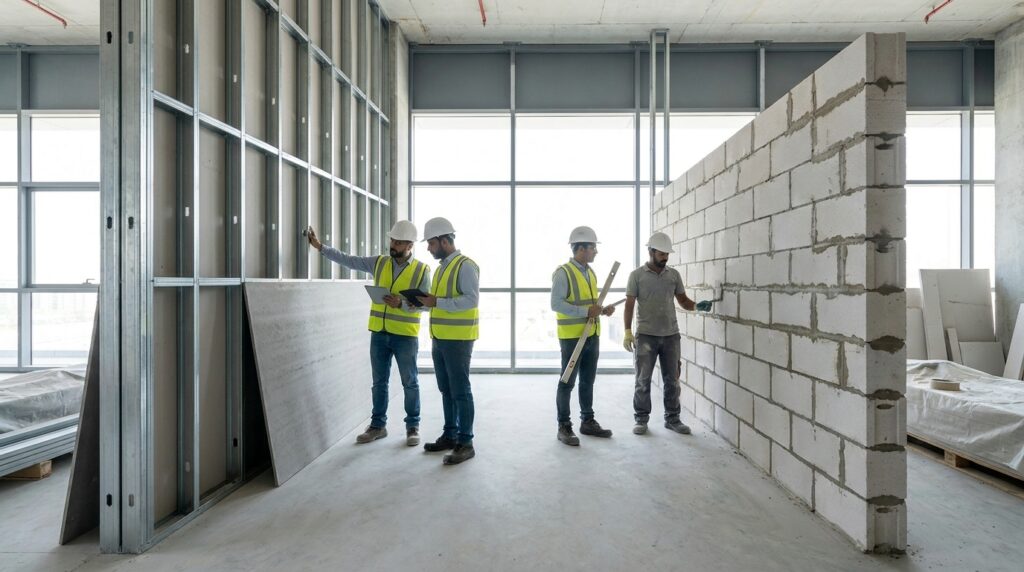
When you are deciding on partition materials for a UAE development project, fiber cement board and AAC blocks are two of the most common options on the table. Both are lighter than traditional masonry, both handle fire well, and both show up regularly in residential towers, hotels, and commercial fit-outs across Dubai and Abu Dhabi.
But they work very differently on site, and choosing the wrong one for your project type has real consequences for your schedule, your budget, and your finish quality.
This article gives you a straight comparison so you can make the right call before construction starts.
At a Glance
What Each Material Is Made Of
Understanding what these materials are made of helps explain why they behave the way they do.
AAC blocks, short for Autoclaved Aerated Concrete, are made from cement, sand or fly ash, lime, water, and a small amount of aluminium powder. When mixed, the aluminium causes a chemical reaction that fills the block with millions of tiny air bubbles. The result is a block that is much lighter than standard concrete but still structurally solid. AAC blocks are then cured in a high-pressure steam chamber, which gives them their final strength.
Fiber cement board is made from cement, sand, and cellulose fiber pressed into flat sheets. It is dense, dimensionally stable, and built to handle moisture, impact, heat, and fire. Unlike AAC blocks, fiber cement board is a panel system, not a masonry unit, so it is installed with a metal or timber frame rather than stacked with mortar.
If you’re comparing interior panel materials instead of masonry partitions, our Fiber Cement Board vs Gypsum Board: Full Comparison for UAE Projects explains the differences in moisture resistance, durability, fire performance, and ideal applications across UAE construction projects.
AAC Block vs FCB Partition UAE: How They Compare
Installation Method and Speed
This is one of the biggest differences between the two materials, and it matters significantly on projects with tight handover deadlines.
AAC block partitions are a wet construction method. Blocks are stacked with thin-bed mortar or adhesive, then both sides require plastering before any surface finish can be applied. The plastering needs time to cure, which adds days or weeks to the finishing schedule, depending on the scope.
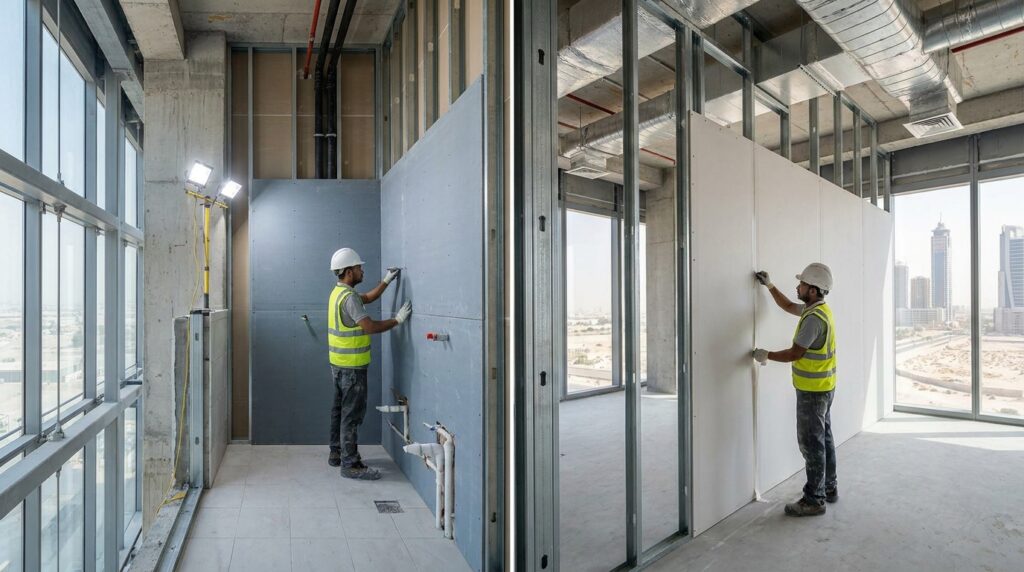
Fiber cement board partition systems are a dry construction method. Panels are fixed to a metal frame, joints are finished, and the surface is ready for paint or tile without plastering or curing. This speeds up the construction program considerably, especially on large floor plates with many internal partitions.
For developers working on high-rise residential towers or commercial buildings with multiple floors of similar layouts, the time saved with a dry partition system across the full project is a meaningful schedule and cost advantage.
Fiber Cement Partition Weight UAE: Structural Load Considerations
Weight is a critical factor in high-rise construction, where structural engineers calculate the cumulative dead load on every floor.
AAC blocks are already much lighter than standard concrete blocks, which is one of the reasons they became popular in UAE high-rise construction. A 100mm AAC block partition wall typically weighs around 60 to 70 kg per square meter.
Fiber cement board partition systems are lighter still. A standard FCB stud partition with 12mm boards on both sides of a metal frame comes in well below that figure. Over an entire floor plate with dozens of partition runs, this weight reduction is reflected in the structural design, and in some cases, allows for reduced slab thickness or steel reinforcement, which feeds back into the overall build cost.
For developers working on tall structures, the fiber cement partition weight that UAE engineers need to account for is a genuine advantage when compared to block-based systems.
Acoustic Performance
Sound control between rooms and between units is a common concern in residential towers, hotels, and office buildings. Both materials offer acoustic performance, but in different ways.
AAC blocks perform well acoustically because of their porous structure, which absorbs sound rather than reflecting it. A standard 200mm AAC block wall can achieve a sound transmission rating that suits most residential and commercial separation requirements.
A fiber cement board partition system can also meet acoustic requirements, but it depends more on the system design: board thickness, stud spacing, insulation within the cavity, and whether single or double boards are used. A well-specified FCB partition system with acoustic insulation in the cavity performs comparably to AAC blocks, but the specification needs to be done properly. An under-specified FCB system will not match the natural acoustic mass of a solid AAC wall.
For hotel bedrooms, residential units, and spaces where sound privacy is a non-negotiable requirement, this is worth factoring into the specification at an early stage.
Moisture Resistance
The UAE climate means moisture resistance matters, both in coastal areas where humidity is high and in wet area applications like bathrooms and kitchens.
Fiber cement board has inherent moisture resistance built into its composition. It does not swell, warp, or lose structural integrity when exposed to water or humidity. It is the standard specification for wet area linings in bathrooms, behind kitchen tiles, and in any partition that is likely to see regular water contact.
AAC blocks are moisture-resistant but not fully waterproof. Unplastered AAC walls absorb water, and proper exterior plastering and waterproofing treatment is needed to protect them over the long term. In internal wet areas, AAC block partitions need additional waterproofing treatment before tiling, which adds both cost and time compared to a fiber cement board system in the same location.
For projects evaluating sheet materials for walls, ceilings, or joinery, see our Fiber Cement Board vs Plywood: Cost, Strength & Durability in UAE Climate to understand which material performs better under heat, humidity, and long-term exposure.
Fire Performance
Both materials perform well under fire conditions, which is why both are used in UAE projects where fire code compliance is reviewed during approvals.
AAC blocks are non-combustible and provide a high level of fire resistance due to their mass and composition. Standard AAC block walls of sufficient thickness can achieve fire ratings that meet commercial building code requirements.
Fiber cement board is also non-combustible. The boards are made primarily from cement, so they do not burn or contribute to flame spread. FCB partition systems can be specified and tested to meet specific fire ratings depending on the board thickness, stud system, and cavity configuration.
Neither material is a weak choice for fire performance. The difference is that AAC blocks achieve fire resistance through mass, while FCB systems achieve it through the tested assembly configuration.
Lightweight Block Alternative: When FCB Is the Better Fit
The search for a lightweight block alternative in UAE construction often points to AAC blocks, and for good reason. They are lighter than traditional masonry, widely available, and familiar to most site teams. But fiber cement board panel systems take the weight advantage further and add speed, which is why they are increasingly specified as the preferred lightweight block alternative in large commercial and high-rise residential projects where program and load are both primary concerns.
FCB partition systems also offer more flexibility for future reconfiguration. If a floor layout needs to change after handover, a stud partition with fiber cement board can be relocated without breaking down and rebuilding, as a block wall requires. For commercial spaces in particular, this is a practical consideration.
If you’re also comparing fiber cement board with conventional brick and block construction, read our guide on Is Fiber Cement Board Cheaper Than Traditional Masonry in UAE? to understand how material costs, labor, installation speed, and structural load affect the overall project budget.
Which One Is Right for Your Project?
There is no single answer that applies to every project, but some clear patterns emerge from the comparison.
AAC blocks are a strong choice when acoustic separation is a top priority, and the construction program allows for wet trades and curing time. They also suit projects where the site team has more experience with masonry systems than dry construction methods.
Fiber cement board partition systems are the stronger choice when program speed matters, when structural load needs to be minimized on upper floors, when wet area performance is required, or when the project involves commercial spaces that may need reconfiguration in the future.
On many large mixed-use UAE developments, both materials appear in the same project: AAC blocks used where acoustic mass is the primary requirement, and fiber cement board systems used in wet areas, fast-track floors, and spaces where weight and flexibility are priorities.
Commercial developers comparing modern partition systems should also read Cement Board vs Drywall for Commercial Projects in UAE, where we compare installation speed, maintenance, fire ratings, and long-term performance for offices, retail spaces, and hospitality projects.
Conclusion
Fiber cement board vs AAC blocks is not a straightforward win for either material. AAC blocks offer natural acoustic mass and a familiar installation method. Fiber cement board systems offer speed, lower weight, and better wet area performance.
For UAE developers and project managers, the right specification depends on the project type, the floor load requirements, the acoustic needs, and the construction schedule. Getting this decision right at the specification stage, rather than on site, is where the real cost saving happens.
If you’re evaluating multiple construction materials beyond AAC blocks, our Fiber Cement Board vs Other Building Materials: A UAE Comparison provides a comprehensive overview of how fiber cement board compares with gypsum board, plywood, drywall, and other commonly used materials for UAE projects.
To discuss which partition system is right for your UAE project, contact Geminite at this Contact Form.
FAQs
-
What is the main difference between fiber cement board and AAC blocks for UAE partitions?
FCB is a dry panel system that installs faster, while AAC blocks are a wet masonry system with better natural acoustic mass.Which is lighter, fiber cement board or AAC blocks?
Fiber cement board partition systems are generally lighter than AAC block walls of comparable thickness, making them a stronger choice where floor load is a concern.Is fiber cement board a good lightweight block alternative in UAE construction?
Yes, particularly in high-rise and commercial projects where program speed and structural load reduction are both priorities.How does the fiber cement partition weight in UAE projects need to be accounted for compared to AAC?
FCB stud partitions typically carry a lower dead load per square meter than 100mm or 200mm AAC block walls, which can reduce structural requirements on upper floors.Which material is better for wet area partitions in UAE bathrooms?
Fiber cement board is a better specification for wet areas because it resists water without needing additional waterproofing treatment before tiling.Do AAC blocks perform better acoustically than fiber cement board partitions?
A solid AAC block wall naturally achieves higher acoustic mass, but a well-specified FCB partition system with cavity insulation can match it in most residential and commercial applications.Which is faster to install, FCB or AAC blocks?
Fiber cement board is faster because it uses a dry construction method with no plastering or curing time required.Can fiber cement board and AAC blocks be used in the same project?
Yes, and this is common practice on large UAE developments where each material is specified based on the requirements of each area.Are AAC blocks or fiber cement board more fire-resistant?
Both are non-combustible and meet fire code requirements. AAC achieves fire resistance through mass, while FCB systems meet fire ratings through the tested panel assembly.Which is better for a high-rise residential tower in the UAE?
Fiber cement board partition systems generally suit high-rise projects better due to lower weight, faster installation, and strong wet area performance, though AAC blocks may be used in specific areas where acoustic separation is the priority.
At a Glance