

- New
- November 10, 2026
Moisture Resistant Drywall vs Cement Board: Which Wins in UAE Wet Areas?
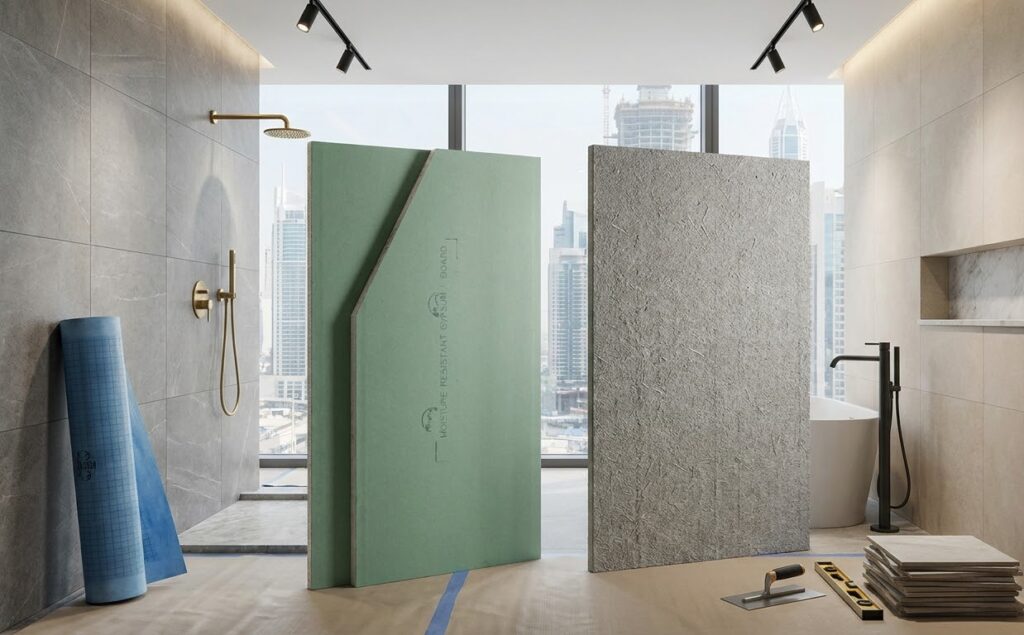
Most people shopping for bathroom wall materials think they are choosing between two options. They are actually choosing between three.
Standard drywall. Moisture-resistant drywall. Cement board.
Each one handles water differently. Each one belongs in different parts of a wet area. And in the UAE, where humidity is sustained for months, where building density means bathroom failures become neighbour problems, and where fit-out repair costs are high, getting this choice wrong is an expensive mistake.
At a Glance
What Moisture-Resistant Drywall Actually Is
Moisture-resistant drywall goes by several names in the UAE market. Green board is the most common term, named for its green-coloured facing paper. Purple board is a newer variant from certain manufacturers, claiming improved mould resistance alongside moisture resistance.
Both are still gypsum board at their core.
The difference from standard drywall is the facing. Green board uses a treated, water-repellent paper or fibreglass facing instead of standard paper. The gypsum core itself is also sometimes treated to slow moisture absorption. These modifications make the board handle ambient humidity better than standard drywall.
What they do not do is make the board waterproof.
When water reaches the gypsum core, whether through a failed tile grout joint, a cracked sealant around a fixture, or sustained condensation in a poorly ventilated bathroom, moisture-resistant drywall absorbs it. Slowly. But it absorbs it. And once absorbed, the degradation process begins.
What Cement Board Actually Is
Cement board is Portland cement, silica sand, and cellulose or glass-fibre reinforcement pressed into a dense sheet. There is no paper facing. There is no gypsum core. The entire board is cement-based.
When water contacts cement board, there is no gypsum core to absorb it. The board stays dimensionally stable. It does not swell, soften, or change shape. This is the fundamental performance difference between the two materials, and it is the reason cement board is specified in shower enclosures and high-moisture wet areas while moisture-resistant drywall is not.
One important clarification that most guides skip: cement board is not fully waterproof either. Water can still migrate through the board under sustained direct exposure, particularly at cut edges and fastener penetrations. In shower applications, a waterproofing membrane, either sheet-applied or liquid-applied, is still required behind or over the cement board before tiling. Cement board provides dimensional stability and a strong tile substrate. The membrane provides the waterproofing.
For a broader comparison of these materials across dry interiors, exterior applications, and commercial spaces, read our guide to Gypsum Board vs Cement Board UAE: Which Is Better for Your Project?.
Green Board vs Cement Board UAE: The UAE-Specific Context
This comparison has a different weight in the UAE than in milder climates, and here is why.
A green board wall in a dry UK or Canadian bathroom experiences ambient humidity occasionally. In the UAE, from June through September, relative humidity on the coast sits persistently high. Air conditioning units cycle moisture through internal spaces. Bathrooms in UAE residential buildings are used by large households, hotel rooms see daily use, and commercial wet areas in gyms and hospitals operate at very high frequency.
That sustained moisture exposure accelerates the timeline for green board degradation. A moisture-resistant drywall installation that might last eight years in a mild climate can show problems within three to five years in a UAE bathroom under the same conditions.
The performance gap between green board and cement board in UAE wet areas is wider than what most international product guides describe. Design for the climate you are building in, not the climate the product was tested in.
Water-Resistant Drywall vs Cement Board UAE: Where Each One Belongs
The right answer is not one material throughout. It is the right material in the right zone.
Beyond gypsum and cement board, UAE contractors also need to consider other options such as plywood, foam board, and brick. Explore our Fiber Cement Board vs Other Building Materials: A Complete UAE Comparison to understand how these materials compare across different construction applications.
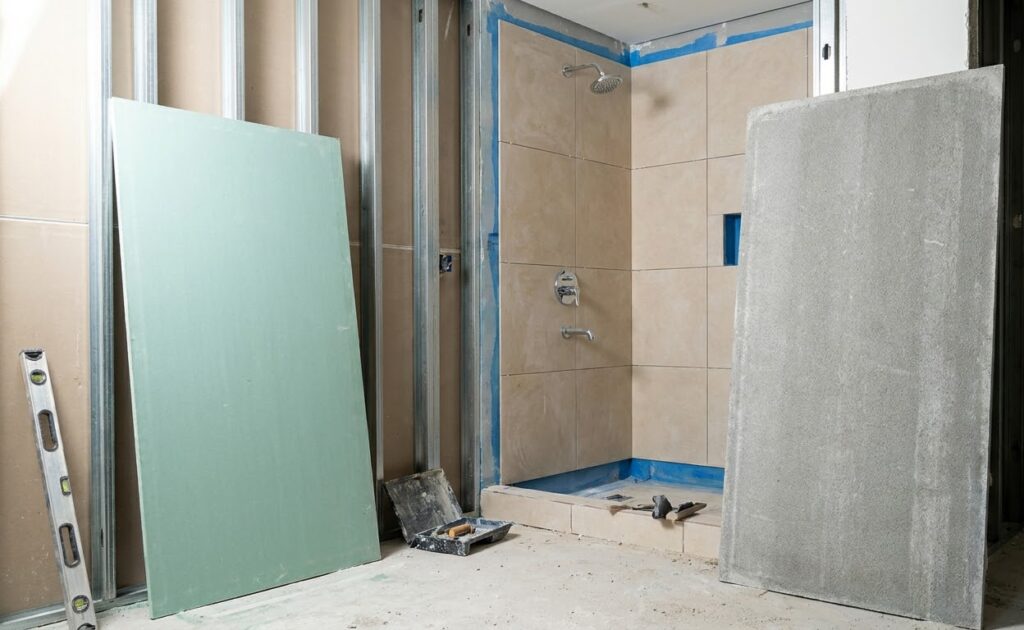
Shower enclosures and tub surrounds. Cement board only. This is not a preference. Green board is not an approved tile backer for direct shower application under most UAE and international building standards. The constant water contact, the steam, and the tile adhesive bond requirements all point to cement board. A waterproofing membrane behind the tiles is required regardless of which board is used.
Bathroom walls within the splash zone. Cement board. Any wall within range of water from the shower head, the bath, or the sink should use cement board as the substrate. Defining the splash zone conservatively is the safer specification.
Bathroom walls outside the splash zone. Moisture-resistant drywall is acceptable here. Walls at the far end of the bathroom, away from direct water contact, experience humidity but not direct splash. Green board handles this adequately and costs less than cement board. In UAE conditions, adequate ventilation in the bathroom and a quality paint finish on the green board reduce the risk of ambient moisture causing problems on these non-splash walls.
Bathroom ceilings in residential settings. Moisture-resistant drywall works in most residential bathroom ceilings where the ceiling is not directly above a shower area. In hotel bathrooms, wet rooms, and commercial settings where steam and humidity are more intense and more sustained, cement board on the ceiling is the safer long-term specification.
Kitchen splash zones. Cement board behind tiles in cooking and sink areas. The combination of steam, grease, water contact, and frequent cleaning with cleaning agents makes this equivalent to a bathroom wet zone.
Laundry rooms and utility areas. Moisture-resistant drywall is usually adequate for walls not in direct contact with water. Cement board for any wall behind sinks, appliances, or in direct contact with wet surfaces.
Best Board for Wet Areas UAE: The Cost Picture
Green board costs more than standard drywall but significantly less than cement board. In UAE market pricing, moisture-resistant drywall sits roughly 25 to 30 percent above standard gypsum board. Cement board runs 20 to 35 percent above standard gypsum on its own, but that comparison understates the total cost difference because cement board in wet areas eliminates the additional waterproofing treatment that green board requires before tiling.
Green board used as a tile substrate in a wet area needs a waterproofing membrane applied over it before tiles go on. Cement board also benefits from a waterproofing membrane, but the risk of failure without one is significantly lower because the board itself does not degrade when water contacts it. On a cost-per-square-metre basis, comparing the boards alone gives a misleading picture of the true total cost of each specification.
For large UAE projects with many wet area bathrooms, the procurement decision should factor in the board price, the waterproofing treatment cost, the installation labour difference, and the expected maintenance cost over the building lifecycle. Cement board in showers and direct wet zones, and moisture-resistant drywall in non-splash areas, is the specification that optimises cost and performance across the full bathroom scope.
The Waterproofing Membrane Question
Both materials perform better with a waterproofing membrane in wet area applications. But the membrane serves a different purpose depending on which board is underneath.
Behind green board, the membrane is doing the primary waterproofing work. The board is the substrate, and the membrane is what actually keeps water from reaching the gypsum core. If the membrane is breached at any point, the green board is exposed.
Behind cement board, the membrane adds an additional layer of protection over a substrate that is already water-resistant. If the membrane is breached, the cement board does not immediately degrade. It provides a buffer that green board cannot.
In the UAE, where construction timelines are sometimes compressed and quality control on membrane application varies, that buffer matters.
Apart from moisture resistance, contractors should also consider thermal insulation and the suitability of lightweight boards for different applications. Read our guide to Gypsum Board vs Foam Board UAE: Which Should Contractors Choose? to compare their performance, fire safety, and installation requirements.
Conclusion
Moisture-resistant drywall and cement board are not competing for the same application.
Green board handles bathroom humidity in non-splash wall zones adequately and at lower cost. Cement board handles direct water contact, shower enclosures, and sustained high-moisture conditions that green board was never rated for.
In UAE wet areas, where humidity is sustained and bathroom use is frequent, the performance gap between the two materials is wider than most product guides designed for milder climates acknowledge.
For a broader comparison of fibre cement board and plywood, including their cost, strength, durability, and suitability for UAE buildings, read Fibre Cement Board vs Plywood: Which Is Better for UAE Buildings?
To source cement board and moisture-resistant boards for UAE wet area projects, contact Geminite.
Frequently Asked Questions
Is moisture-resistant drywall the same as waterproof drywall?
No. Moisture-resistant drywall resists ambient humidity better than standard drywall, but the gypsum core still absorbs water when directly exposed. It is water-resistant, not waterproof.
Can green board be used in a UAE shower enclosure?
No. Green board is not rated for direct water contact applications like shower enclosures. Cement board is the correct specification for shower walls and tub surrounds.
Is cement board fully waterproof?
No. Cement board is dimensionally stable when wet and does not absorb moisture the way gypsum does, but a waterproofing membrane is still required in shower applications for full waterproofing protection.
What is the best board for wet areas in UAE bathrooms?
Cement board in shower enclosures, splash zones, and direct wet contact areas. Moisture-resistant drywall on non-splash bathroom walls where ambient humidity is the primary concern.
How does UAE humidity affect moisture-resistant drywall compared to milder climates?
Sustained coastal humidity from June through September accelerates green board degradation compared to milder climates. Boards that might last eight years elsewhere can show problems within three to five years in high-use UAE bathrooms.
Does cement board need a waterproofing membrane in UAE shower applications?
Yes. Cement board provides dimensional stability and a strong tile substrate, but a liquid or sheet waterproofing membrane should still be applied before tiling in direct shower applications.
What is the cost difference between green board and cement board in UAE?
Moisture-resistant drywall costs roughly 25 to 30 percent more than standard gypsum. Cement board costs 20 to 35 percent more than standard gypsum, but eliminates some of the additional waterproofing treatment cost that green board requires as a tile substrate.
Which board is better for bathroom ceilings in UAE hotels and commercial buildings?
Cement board is the safer specification in high-use commercial bathrooms where steam and humidity are more sustained. Moisture-resistant drywall is acceptable in residential bathroom ceilings away from direct shower spray.
Can moisture-resistant drywall and cement board be used in the same UAE bathroom?
Yes, and this is the correct approach. Cement board in the shower enclosure and splash zones, moisture-resistant drywall on walls outside the direct wet zone.
Does mould grow on cement board in UAE wet areas?
Cement board is significantly more mould-resistant than drywall because of its inorganic composition. Mould can still develop if moisture accumulates without proper waterproofing and ventilation, which is why correct installation practice matters regardless of board type.
At a Glance