

- New
- November 4, 2026
Fiber Cement Board vs Other Building Materials: A Complete UAE Comparison
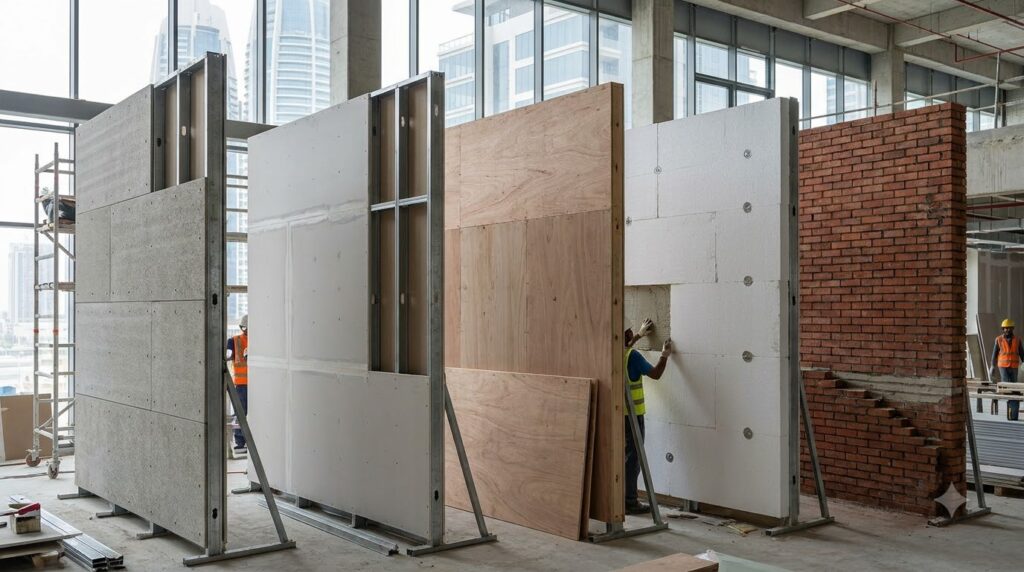
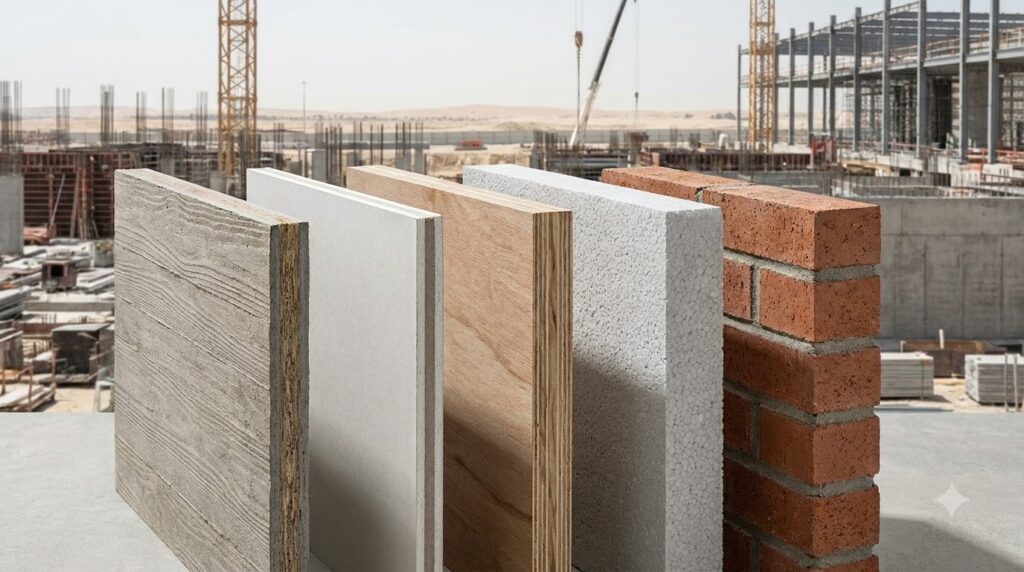
The UAE construction market uses dozens of wall and ceiling materials across different project types. Four of them come up in almost every specification conversation: fiber cement board, gypsum board, plywood, and brick. A fifth, foam board, shows up in insulation and lightweight partition discussions with enough frequency to deserve a clear answer.
Each material has a place. Each one also has conditions where it fails. The fiber cement board vs gypsum UAE question is the most common starting point, but developers, contractors, and fit-out teams regularly need to compare FCB against all of these materials before a specification is locked.
This guide gives you a clear, honest comparison across all five. The cluster articles linked throughout go deeper on each specific pairing for buyers who need detailed cost breakdowns, application guides, or wet area performance data.
At a Glance
Why These Comparisons Matter More in the UAE
Material performance does not exist in a vacuum. It exists in a climate, a construction program, a budget, and a compliance framework.
The UAE climate attacks building materials from several directions at once. Summer surface temperatures exceed 60 degrees Celsius. Coastal humidity sits high for months. Dust storms abrade exterior surfaces. The temperature swing between a summer afternoon and a winter night puts thermal stress on every panel, board, and block in the building.
On top of the climate, Dubai Civil Defence fire codes have tightened significantly since 2017. Non-combustible materials are required for external cladding. Fire-rated assemblies are required for partition walls in escape routes and high-rise cores. Compliance is not optional, and material choice directly affects whether a building passes approvals.
All of the comparisons below are evaluated through both of those lenses: performance in UAE conditions and compliance with UAE codes.
Fiber Cement Board vs Gypsum Board
This is the comparison UAE construction teams make most often. Gypsum board is the default for interior walls and ceilings across the region. It is light, smooth, cheap, and fast to install. For large volumes of dry interior space, it is usually the right call.
The problem starts when gypsum is specified outside of those conditions.
Gypsum board is a soft mineral core between two sheets of paper. It absorbs moisture. Even moisture-resistant gypsum board, the green-faced variety common in UAE fit-outs, is rated for indirect humidity exposure, not for direct or sustained water contact. Put it in a shower, a kitchen splash zone, or an exterior soffit, and it will soften, sag, grow mold, and eventually fail.
Fiber cement board is cement, sand, and cellulose fiber. No paper facing. No soft core. It does not absorb water. It does not soften in steam. It does not crack under impact the way gypsum does in a busy corridor.
The cost picture is straightforward. Gypsum board costs less per square meter, with standard sheets in the UAE running well below FCB pricing at comparable thickness. For dry interior rooms, gypsum is the practical and cost-effective specification. For wet areas, exteriors, high-traffic commercial spaces, and fire-rated assemblies, FCB is the correct board and the cheaper option over the building lifecycle because it does not need to be replaced.
The weight difference matters too. Gypsum board is roughly half the weight of FCB at comparable thickness, which means faster installation, simpler ceiling grid design, and lower cumulative load on upper floors. For large commercial ceilings in dry areas, this weight advantage is real and relevant.
For a more detailed comparison of moisture resistance, impact resistance, fire performance, installation, and costs, read our guide to gypsum board vs cement board UAE to identify the right specification for your project.
The cement board vs drywall UAE comparison follows the same logic. Drywall and gypsum board are the same material. The terminology shifts depending on the market, but the product is identical. A full breakdown of this pairing across wet areas, commercial fit-outs, and fire-rated applications is covered in Gypsum Board vs Cement Board UAE: Which Is Better for Your Project?
Fiber Cement Board vs Moisture-Resistant Drywall
Moisture-resistant drywall deserves its own section because it is frequently specified in UAE bathrooms and kitchens as a cheaper alternative to FCB. The assumption is that the moisture-resistant designation makes it suitable for wet areas. It does not.
Moisture-resistant drywall, whether it uses a green face or a fiberglass facing, is designed to handle ambient humidity, not direct water exposure. The gypsum core is still present. When water gets behind tiles through failed grout lines or around fixtures, it reaches the board. At that point, the moisture-resistant designation offers limited protection. The core absorbs water slowly rather than quickly, but it still absorbs it. Given enough time and enough moisture cycling, it deteriorates.
FCB does not have a gypsum core. There is nothing in the board that absorbs water. This is not a marginal performance difference. It is a structural one. In a UAE bathroom that will be used daily for ten years, the difference between moisture-resistant drywall and FCB is the difference between a wall that needs rebuilding after five years and one that does not.
The specific performance comparison across UAE wet area applications, including splash zones, shower walls, and kitchen linings, is covered in Moisture Resistant Drywall vs Cement Board: Which Wins in UAE Wet Areas?
Fiber Cement vs Plywood UAE
Plywood has been a common construction material for decades, and it still shows up regularly in UAE renovation work, furniture, cabinetry, and formwork. As a primary wall and partition board in new UAE construction, it has largely been replaced by gypsum and FCB systems. The reasons are climate-specific.
Plywood is made from wood. Wood absorbs moisture. In the UAE, where coastal humidity is sustained for months and inland temperature swings are extreme, standard plywood warps, delaminates, and weakens under the conditions the climate creates. Marine-grade plywood handles moisture better, but even marine-grade plywood underperforms FCB on a coastal UAE facade over five to ten years of weathering.
Termites are the second issue. Plywood is organic. It is a direct food source for termites, which are active across many UAE locations. FCB contains no organic material in its structural matrix. There is nothing for termites to eat. This is one of the primary reasons FCB has taken over in applications where plywood once dominated: it removes the pest risk entirely.
Fire performance is the third issue. Plywood burns. FCB is non-combustible. In commercial buildings where fire codes restrict the use of combustible materials in wall and ceiling systems, plywood is simply not a compliant option in those applications.
Where plywood retains a genuine advantage is in workability, tensile strength for curved or complex forms, and applications where its wood properties are assets rather than liabilities: furniture, cabinetry, formwork, and specific structural uses. As a primary exterior or wet area wall board in UAE construction, it is the weakest of the three options.
A full cost, strength, and durability breakdown of this pairing is in Fibre Cement Board vs Plywood: Which Is Better for UAE Buildings?
Gypsum Board vs Foam Board UAE
Foam board, also called EPS board or expanded polystyrene, is an insulation material. It appears in UAE construction primarily in external wall insulation systems, underfloor insulation, and some lightweight partition applications. It is not a structural board and was never designed to be one.
The comparison with gypsum board comes up most often in the context of lightweight internal partitions where developers or contractors are looking for ways to reduce weight and cost. Foam boards are extremely light and have good thermal insulation properties. Those are genuine advantages.
The limitations are significant. Foam board has almost no structural strength. It cannot support fixings, take impact, or carry loads. It is combustible, which limits where it can be used in buildings subject to fire codes. And it has no moisture resistance advantage over gypsum in the way FCB does.
In practice, foam board and gypsum board are not direct substitutes. They serve different purposes. Foam board is insulation. Gypsum board is a wall finish and partition system. On projects where thermal performance of internal walls matters, the correct approach is often a composite: gypsum or FCB as the structural partition face, with foam board insulation within the cavity or behind the panel system.
For contractors trying to decide between gypsum and foam board for a specific partition application, the detailed breakdown is in Gypsum Board vs Foam Board UAE: Which Should Contractors Choose?
Cement Board vs Brick Wall UAE
Brick and block masonry is one of the oldest construction methods in the UAE and still has active applications in structural walls, boundary walls, and low-rise residential construction. The comparison with FCB comes up most often in the context of internal partitions on large commercial or high-rise residential projects, where developers are weighing a traditional wet-trade wall system against a modern dry partition system.
The performance difference between a well-built masonry wall and a correctly specified FCB stud partition is small in most structural and fire-related metrics. Both are non-combustible. Both are durable over a long building life. Both meet UAE code requirements when correctly specified.
The cost and program difference is where FCB systems consistently pull ahead in the UAE market.
Brick and block walls are a wet trade. They go up course by course. Both faces need plastering and curing before the wall is ready for a surface finish. On a large floor plate with many internal partitions, this process takes weeks. A dry FCB partition system goes up faster, needs no plastering or curing time, and is ready for paint or tile as soon as the joints are finished.
For high-rise construction, the weight advantage of FCB partition systems is also real. A 100mm block wall weighs significantly more per square meter than an FCB stud partition. Across dozens of floors with hundreds of metres of partition runs, that weight reduction affects structural design, slab thickness calculations, and, in some cases, the total steel requirement of the building frame.
The total installed cost comparison, including material, labor, wet trades, and program implications, is covered in Cement Board vs Brick Wall UAE: Full Cost and Performance Comparison.
Choosing the Right Material: A Practical Framework
No single material wins every comparison. The right specification depends on three things: where the board is going, what conditions it will face, and what the project budget and program can support.
Dry interior rooms in residential and commercial buildings are well served by gypsum board. It is cheaper, lighter, and faster than FCB in those conditions. Using FCB throughout a project regardless of application adds cost and weight without adding performance.
Wet areas, exterior surfaces, high-traffic commercial spaces, and fire-rated assemblies require FCB. In these applications, gypsum fails faster than the cost difference between the two materials is ever recovered.
Plywood belongs in cabinetry, furniture, formwork, and specific structural applications where its wood properties are advantages. It does not belong on exterior walls, in wet areas, or in any application where moisture, fire, or termites are realistic risks.
Foam board belongs in insulation layers within wall assemblies, not as a structural partition face or a substitute for gypsum or FCB on finished surfaces.
Masonry belongs in structural perimeter walls, boundary applications, and low-rise construction where program speed is less critical. For internal partitions on large commercial or high-rise projects, FCB dry systems are faster, lighter, and generally more cost-effective when total installed cost is measured.
Building Material Comparison UAE: The One Rule That Cuts Through Everything
Match the material to the conditions. Not to the price list.
A gypsum board in a dry bedroom is a correct, cost-effective specification. The same board behind bathroom tiles is a five-year problem. An FCB panel on an exterior facade is the right call. The same panel in a dry office corridor is an unnecessary cost. Plywood in a kitchen cabinet is fine. The same material on an exterior wall in a coastal UAE location is a maintenance liability from year one.
The price difference between these materials matters. But it matters in context. The cheapest board for a given application is the one that performs correctly in that application for the longest time with the least maintenance intervention. In most UAE conditions that involve moisture, impact, fire, or outdoor exposure, that board is FCB. In dry interior rooms where none of those factors apply, that board is gypsum.
Conclusion
The fiber cement board vs gypsum UAE comparison, and the broader comparison against plywood, drywall, foam board, and brick, always comes back to application. Each material is built for specific conditions and underperforms outside of them.
Getting the specification right before construction starts is cheaper than fixing the wrong material choice after handover. The articles linked throughout this guide go deeper on each specific pairing with cost data, application guides, and UAE-specific performance context.
To discuss the right board for your next UAE project, contact the Geminite team. Here.
Frequently Asked Questions
What is the main difference in a fiber cement board vs gypsum UAE comparison?
Fiber cement board resists moisture, impact, and fire in a way gypsum cannot. Gypsum is lighter, cheaper, and correct for dry interior applications where those factors are not relevant.
Is cement board vs drywall UAE the same comparison as FCB vs gypsum?
Yes. Drywall and gypsum board are the same product. The terminology differs by market, but the material and the comparison are identical.
Which is better for UAE wet areas: moisture-resistant drywall or cement board?
Cement board. Moisture-resistant drywall handles ambient humidity but not sustained or direct water contact. FCB has no gypsum core to absorb water, making it the correct specification for bathrooms and kitchens.
Is fiber cement vs plywood UAE a relevant comparison for modern construction?
Yes, particularly in renovation work and some structural applications. For exterior walls, wet areas, and fire-rated assemblies, FCB outperforms plywood on every relevant metric in UAE conditions.
Can foam board replace gypsum board for UAE wall partitions?
No. Foam board is an insulation material, not a structural partition face. It cannot support fixings, take impact, or replace gypsum or FCB as a finished wall surface.
Is FCB or brick better for internal partitions in UAE high-rise buildings?
FCB stud partitions are generally better for internal partitions in high-rise UAE buildings because they are lighter, faster to install, and produce the same fire and structural performance without the wet trade delays of masonry.
What does building material comparison UAE buyers should do before specifying?
Map each surface by its exposure conditions: moisture, impact, fire rating, and outdoor versus indoor. Then match the material to those conditions rather than selecting based on price per sheet alone.
Is gypsum board suitable for exterior use in UAE buildings?
No. Gypsum board is not rated for outdoor exposure and will deteriorate under UAE weather conditions regardless of whether a moisture-resistant variant is used.
Does FCB cost more than gypsum board in UAE?
Yes, per square meter, FCB costs more upfront. In wet areas and exterior applications, it costs less over the building lifecycle because it does not need to be replaced or repaired the way gypsum does under those conditions.
Which material is best for fire-rated wall assemblies in UAE commercial buildings?
Both FCB and gypsum board can be used in fire-rated assemblies when correctly specified and tested. FCB is non-combustible by composition. Gypsum achieves fire resistance through the water held in its crystal structure. The correct choice depends on the specific fire rating required and the tested assembly configuration.
At a Glance