

- New
- November 6, 2026
Gypsum Board vs Cement Board UAE: Which Is Better for Your Project?
Here is the question most people ask wrong.
They type “gypsum board vs cement board UAE” expecting one winner. One material that beats the other across every application. That answer does not exist. And any content that gives you one answer isn’t telling the full story.
The right answer is: cement board wins in some rooms, and gypsum wins in others. Knowing which one goes where is the difference between a wall that lasts 20 years and one that needs rebuilding in 5.
At a Glance
What Each Board Is Made Of
The performance difference between these two materials starts with composition.
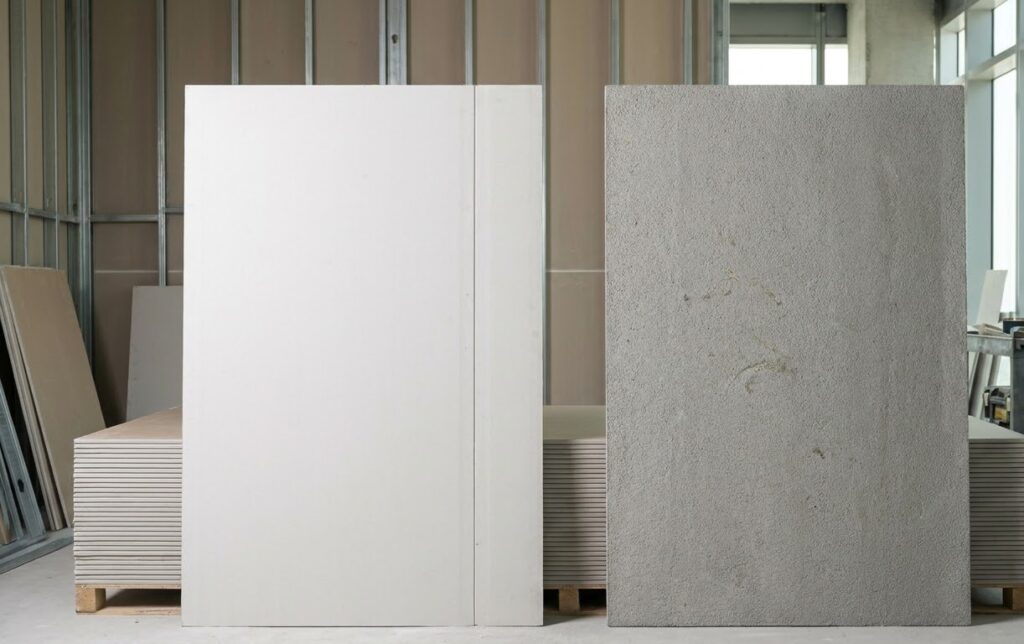
Gypsum board is a soft mineral called gypsum, pressed between two sheets of paper. The core is lightweight and smooth. It takes paint and plaster well. It is easy to cut with a standard knife. It is the most widely used interior wall and ceiling material in the UAE and globally.
Cement board is cement, sand, and cellulose or glass fiber reinforcement pressed into a dense sheet. No paper facing. No soft core. It is heavier, harder to cut, and more expensive per sheet. It is built for conditions that gypsum cannot handle.
That composition difference explains every performance gap between them.
Gypsum vs Fiber Cement UAE: The Core Performance Gaps
Moisture resistance. This is the defining difference. Gypsum absorbs moisture. Standard gypsum board in a humid environment softens over time. Moisture-resistant gypsum board, the green-faced variant, handles ambient humidity better but still carries a gypsum core that absorbs water when the surface is breached. Cement board does not absorb water. The cement and sand matrix is dense enough that moisture does not penetrate under normal conditions.
Impact resistance. Cement board is significantly harder than gypsum. It resists dents, surface damage, and the kind of knocks that busy corridors, commercial kitchens, and high-traffic spaces create daily. Gypsum dents and chips under the same contact. In a hotel corridor or a school, that difference shows up within months of handover.
Fire performance. Both materials perform well under fire but in different ways. Gypsum board contains water bound into its crystal structure. When exposed to fire, that water is released as steam, which slows flame spread and heat transfer through the board. Cement board is non-combustible by composition. Neither material burns or contributes to flame spread. For most UAE fire code applications, both can be used in fire-rated partition assemblies when correctly specified and tested as a system.
Weight. Gypsum board weighs roughly 7 to 15 kg per square meter depending on thickness. Cement board runs from 8 to 25 kg per square meter. For large false ceilings in dry interior spaces, this weight difference affects the grid specification and the cumulative load on the structure. In high-rise buildings, it adds up across every floor.
Cost. Gypsum board costs less per square meter. In the UAE market, cement board runs roughly 20 to 35 percent higher than standard gypsum at comparable thickness. Moisture-resistant gypsum sits in between. The cost gap narrows when total installed cost is compared in wet area applications, where cement board requires no additional waterproofing treatment before tiling and gypsum does.
Workability. Gypsum board cuts with a standard utility knife. Cement board requires carbide-tipped tools and saw blades. It is heavier and more difficult to maneuver on site. Installation is slower and needs more skilled labor for a clean finish. On large interior fit-out projects in dry spaces, this workability difference is a real cost driver.
For a broader understanding of how these materials compare with other construction options, explore our guide to fiber cement board vs other building materials in UAE, covering gypsum, plywood, foam board, and brick across different project applications.
Is Cement Board Better Than Gypsum UAE: Application by Application
The question “is cement board better than gypsum UAE?” only has a useful answer when the application is specified.
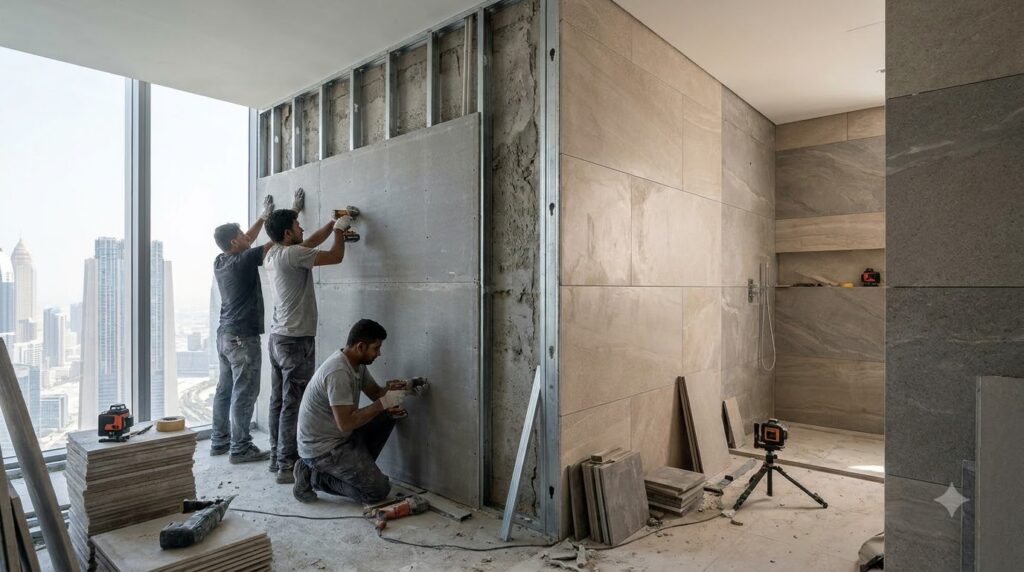
Shower walls and wet rooms. Cement board. No qualification. Gypsum behind shower tiles, even moisture-resistant gypsum with a membrane, is a risk in the UAE climate. Water works behind tiles through grout joints and fixture penetrations over time. When it reaches a gypsum core, the board begins to soften. Cement board gives water nothing to degrade. It is the correct specification for any surface with direct, sustained, or frequent water contact.
Bathroom walls outside the shower zone. This is where MR gypsum becomes a viable option. Walls away from direct splash, with adequate ventilation, can use moisture-resistant gypsum without the same failure risk. For high-end residential or commercial bathrooms where long-term reliability matters, cement board throughout is the cleaner specification. For budget-sensitive projects where only the shower zone sees direct water, MR gypsum on the non-wet walls is an acceptable call.
Kitchen splash zones. Cement board behind splash tiles and above cooking surfaces. The combination of steam, grease, and frequent cleaning with water makes this an equivalent case to a bathroom. Walls outside the splash zone can use gypsum.
Dry bedrooms, living rooms, offices. Gypsum. Straightforward. Cement board in a dry room adds weight and cost without adding performance. Both boards hold paint, accept fixings, and last the life of the building under those conditions. Gypsum wins on cost and installation speed.
False ceilings in dry rooms. Gypsum. Lighter, faster, cheaper, and performs identically to cement board in a dry interior ceiling. The weight advantage is particularly relevant for large commercial ceilings where cumulative grid load matters.
False ceilings in bathrooms, kitchens, and utility areas. Cement board. A bathroom ceiling sees steam, humidity, and periodic water splashes from shower use. Gypsum in this location softens slowly and eventually sags. Cement board holds without change in the same conditions.
Exterior soffits and facades. Cement board only. Gypsum is not rated for outdoor use under any conditions. UAE sun, wind, humidity, and thermal cycling destroy gypsum in exterior applications within one to two years. Cement board is built for this.
High-traffic commercial corridors and retail fit-outs. Cement board. Daily impact from trolleys, bags, furniture moves, and maintenance access marks gypsum walls visibly within the first year of use. Cement board resists this contact without surface damage.
Gypsum vs Cement Board Bathrooms: The Question That Comes Up Most
This specific comparison deserves a direct answer because it is the most searched version of this topic and the most commonly mishandled in UAE fit-outs.
Standard gypsum board in a bathroom is wrong. This is not a preference. It is a material specification error.
Moisture-resistant gypsum in a bathroom is acceptable only in specific locations: walls away from direct splash, in adequately ventilated spaces, and in residential rather than commercial settings where water exposure is lower in frequency and volume.
Cement board in a bathroom is correct throughout. It costs more per sheet. It does not fail.
The cost of rebuilding a bathroom wall in the UAE after gypsum failure runs from AED 3,000 to AED 8,000 per wall. The price premium of cement board over MR gypsum on a bathroom wall is a fraction of that figure. In a project with multiple bathrooms, this calculation runs in the developer’s favour every time cement board is specified from the start.
The Mixed Specification: What Most UAE Projects Actually Do
The projects that get this right use both materials. They are not competing on the same walls. Each one goes where it performs correctly.
Gypsum goes on every dry interior wall and ceiling. Bedrooms. Living rooms. Office partitions. Dry commercial spaces. Meeting rooms. Anywhere moisture, heavy impact, and outdoor exposure are not factors.
Cement board goes on bathroom walls and ceilings. Kitchen splash zones. Exterior soffits, facades, and balcony ceilings. Corridors in hotels, hospitals, and high-traffic commercial buildings. Ground floor walls adjacent to external moisture sources.
This split keeps total material cost as low as possible while placing the right board in every location that would cause problems with the wrong one.
Conclusion
Gypsum board vs cement board UAE is not a competition with one winner. Gypsum is the correct and more cost-effective specification for dry interior applications. Cement board is the correct specification wherever moisture, impact, outdoor exposure, or high-traffic conditions are real factors.
Specifying gypsum in wet areas to save on material cost creates repair bills that exceed the savings within five years in most UAE bathroom and kitchen applications. Specifying cement board in dry rooms wastes money on performance the space does not need. Match the board to the conditions. The rest follows.
To source cement board and fiber cement boards for your UAE project, contact Geminite at sales@geminite.ae or call +9712-4920555.
Or you can simply click on this link to find our contact form.
Frequently Asked Questions
Is cement board better than gypsum for UAE bathrooms?
Yes. Cement board is the correct specification for any bathroom surface with direct or regular water contact. Gypsum softens over time when moisture reaches the core.
Can moisture-resistant gypsum replace cement board in UAE wet areas?
In light-use bathroom walls away from direct splash, MR gypsum with a waterproof membrane is acceptable. In showers, wet rooms, and commercial wet areas, cement board is the safer specification.
What is the cost difference between gypsum board and cement board in UAE?
Cement board typically costs 20 to 35 percent more per square meter than standard gypsum. MR gypsum sits between the two. Total installed cost narrows in wet areas where cement board needs no additional waterproofing before tiling.
Which board is better for UAE office partition walls?
Gypsum board. In dry office partitions with no moisture exposure, gypsum performs identically to cement board at lower cost and with faster installation.
Can I use gypsum board for exterior walls or soffits in UAE?
No. Gypsum is not rated for outdoor use. UAE heat, UV, and humidity will deteriorate it within one to two years in any exterior application.
Which board handles tile better in UAE kitchen and bathroom applications?
Cement board. It provides a stable, non-absorbent substrate for tile adhesive and does not break down when moisture works behind the tile surface over time.
Does cement board require special tools to install in the UAE?
Yes. Cutting cement board requires carbide-tipped blades. Standard utility knives used for gypsum do not cut cement board cleanly. Fixings must also be corrosion-resistant.
Is gypsum board fire rated in UAE construction?
Yes. Gypsum achieves fire resistance through the water held in its crystal structure, which releases as steam under fire exposure. Both gypsum and cement board can be used in fire-rated assemblies when correctly specified.
How long does gypsum board last vs cement board in UAE conditions?
In dry interior rooms, both last the life of the building with minimal maintenance. In wet areas, gypsum typically shows failure within three to seven years under UAE humidity conditions. Cement board in the same application does not degrade under normal use.
Can gypsum board and cement board be used in the same UAE project?
Yes, and this is standard practice. Gypsum in dry interior spaces, cement board in wet areas, exteriors, and high-traffic commercial zones.
At a Glance