

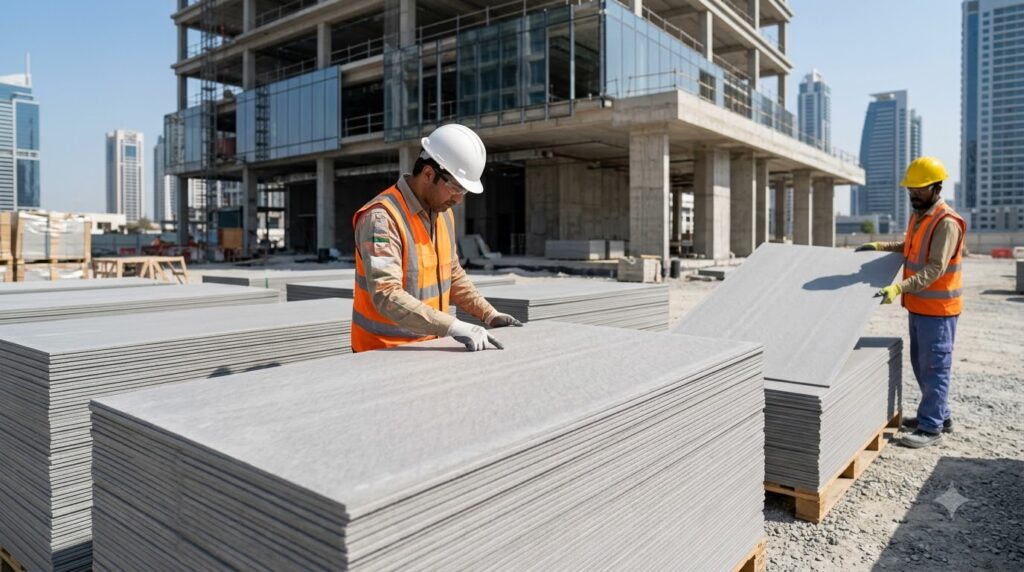
- New
- August 25, 2026
Asbestos-Free Building Boards in UAE: Safe Materials for Modern Construction
Asbestos is banned in the UAE. It has been since 2006. But that ban has not kept it out entirely.
Construction specialists working in Dubai and Abu Dhabi have found asbestos-containing materials in new buildings completed years after the federal prohibition came into force. The material still appears in insulation, gaskets, and boards sourced from suppliers who either did not know or did not disclose what was in their product. The risk is not theoretical. It is documented, ongoing, and carries serious legal consequences for developers and contractors who unknowingly install it.
For anyone specifying or procuring building boards in the UAE today, the question is not just whether asbestos is on the approved materials list. It is how to verify that what arrives on site is genuinely asbestos-free.
At a Glance
What Asbestos Actually Is and Why It Was Used
Asbestos is a naturally occurring mineral. It forms in long, fine fibers. Those fibers are heat-resistant, strong, and bind well with cement. For decades, manufacturers mixed asbestos fibers with cement to produce boards, pipes, roofing sheets, and insulation that were durable, cheap, and easy to make.
The problem is not the material sitting intact in a wall. Intact asbestos does not pose an immediate health risk. The problem is what happens when it is cut, drilled, sanded, damaged, or demolished. The fibers become airborne. When inhaled, they travel deep into lung tissue and stay there. The body cannot expel them. Over years and decades, they cause asbestosis, a scarring of lung tissue, and mesothelioma, a cancer of the lung lining that is difficult to treat and almost always fatal.
There is no known safe level of asbestos fiber exposure. A single significant exposure event can be enough.
The UAE Asbestos Situation: What the Ban Actually Covers
The UAE introduced a federal ban on asbestos board in 2006. Dubai Municipality had already banned asbestos roofing before that. On paper, asbestos board has not been a legal building material in the UAE for nearly two decades.
In practice, enforcement has been uneven. Asbestos-containing materials have been discovered in new construction projects in Abu Dhabi, and Dubai completed well after the ban. The gaps exist for a few reasons. The ban wording has been interpreted narrowly by some suppliers, covering boards but not all asbestos-containing products. Imported materials are not always tested at entry points. And visually, an asbestos cement board and a modern cellulose fiber cement board look identical. Without a lab test on a sample, there is no way to tell them apart on site.
The only way to confirm a board is asbestos-free is documentation from the manufacturer and, where there is any doubt, a sample tested by an accredited laboratory.
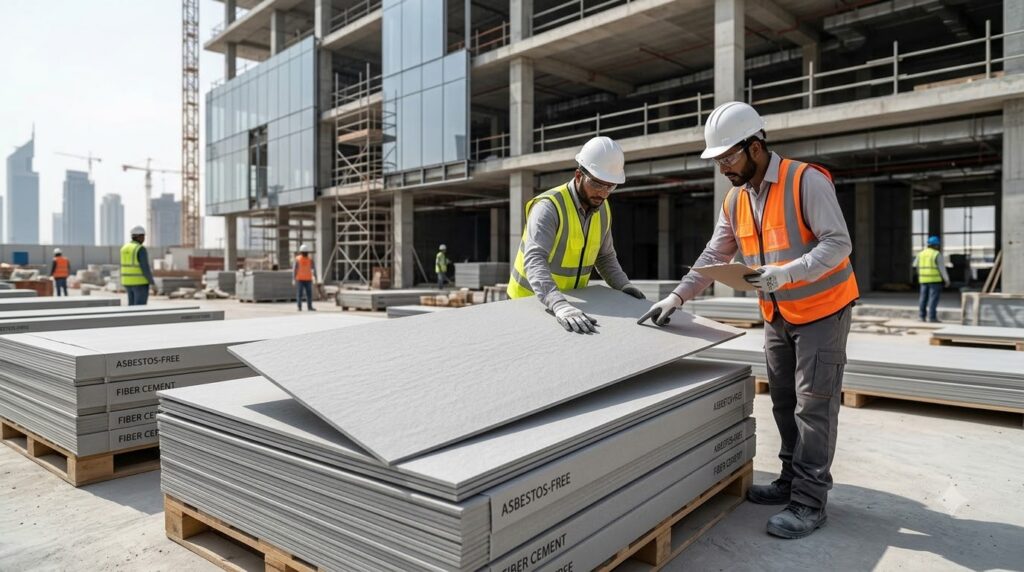
What Modern Cellulose Fiber Cement Board Uses Instead
From the early 1980s onward, manufacturers around the world began replacing asbestos fibers in cement boards with cellulose fiber. Cellulose comes from processed plant material. It is organic, biodegradable, and does not produce harmful airborne particles when cut or disturbed.
The switch was not just about removing a hazardous ingredient. Cellulose fiber gives cement boards flexibility that makes them less brittle under impact. The resulting material, cement bonded with cellulose fiber and reinforced with silica sand, performs comparably to asbestos cement in strength, fire resistance, and moisture resistance, without any of the health risks.
Modern asbestos-free cement board UAE manufacturers produce is made from this cellulose fiber formulation. The boards are dense, non-combustible, moisture-resistant, and fully compliant with international health and safety standards. They do not release harmful fibers when cut, drilled, or broken.
This is the material specified in UAE construction today. But procurement teams need to verify it, not assume it.
For projects where moisture and termite exposure are also concerns, termite-proof wall boards in UAE can provide an additional layer of durability compared with wood-based alternatives.
Beyond being asbestos-free, the material must also withstand the UAE’s demanding climate, making fiber cement board performance in extreme heat and humidity an important consideration when selecting building boards.
Safe Building Board UAE: What to Check Before Procurement
Specifying a safe building board UAE projects need starts with documentation. Three things to request from any board supplier before placing an order.
Asbestos-free certification. A reputable manufacturer provides a written declaration that the product contains no asbestos-containing materials. This should reference the specific product, not just the company. Ask for it before signing any supply agreement.
Product data sheet. The data sheet lists the board composition including fiber type, binder, and aggregate. Cellulose fiber should be explicitly listed as the reinforcing fiber. If the fiber type is not specified, ask why.
Test reports from an accredited laboratory. For high-value or large-volume procurement, request third-party test results confirming the board is free of asbestos fibers. This is standard practice in regulated markets and increasingly expected in UAE commercial construction as awareness grows.
A supplier who cannot produce all three of these documents is a procurement risk regardless of what they say verbally.
Non-Asbestos Board Supplier Dubai: Why Local Manufacturing Matters
The risk of asbestos-containing materials entering the UAE market comes primarily through imports. Boards manufactured overseas, particularly from suppliers in markets where asbestos regulations are weaker or inconsistently enforced, carry a higher risk of undisclosed asbestos content.
A non-asbestos board supplier Dubai or Abu Dhabi-based procurement teams can verify in person is a different proposition. With a locally manufactured product, the manufacturing process, raw material sourcing, and quality control systems are all accessible. Procurement teams can request facility visits, audit raw material documentation, and trace the cellulose fiber supply chain directly.
Geminite manufactures fiber cement boards in the UAE using cellulose fiber, silica sand, and cement. The composition is documented, the production is local, and the boards are fully asbestos-free. For UAE developers and contractors who need to demonstrate compliance on their projects, a locally manufactured board from a traceable supply chain removes the guesswork that comes with imported alternatives.
Cellulose Fiber Board Health Safety UAE: On-Site Handling
Even though modern FCB is asbestos-free, cutting and drilling cement boards produces fine dust. Cement dust contains silica particles. Inhaling silica dust in quantity over time carries its own health risk, separate from asbestos. It is called silicosis and affects workers with sustained, unprotected exposure to silica-containing dust.
This does not make FCB a dangerous product. It makes correct site practice important.
When cutting FCB on site, use a dust-extracting saw or score-and-snap where the board thickness allows. Cutting outside or in a ventilated area reduces dust concentration in the air. Workers cutting FCB regularly should wear an appropriate particulate respirator. A basic dust mask is not enough for fine silica particles.
This is standard site safety practice for any cement-based material. It is not specific to FCB and does not reflect a health risk from the board itself. Undisturbed FCB panels on a wall or ceiling produce no dust and present no health concern to building occupants.
Where the same boards are being considered for fire-sensitive applications, project teams should also understand fire-rated cement board regulations and compliance for UAE buildings before finalising the wall or ceiling system.
How to Confirm a Board Is Asbestos-Free on a UAE Project
If asbestos-containing materials are suspected in any building board, whether in an existing building being renovated or a new delivery of materials on site, visual inspection alone is not enough. Asbestos cement and modern cellulose fiber cement look the same. Texture, color, and weight do not reliably distinguish them.
The correct process is to collect a sample and send it to an accredited laboratory for testing. In the UAE, several specialist consultancies offer asbestos testing and survey services. Do not proceed with cutting, drilling, or demolishing any suspect material until testing is complete.
For new material arriving on site, request the manufacturer’s documentation before any boards are installed. If documentation cannot be produced, do not use the material.
For exterior projects exposed to salt air and coastal humidity, material selection requires additional attention to long-term durability, as discussed in weatherproof exterior boards for UAE coastal buildings.
Conclusion
Asbestos-free cement board UAE construction requires is not just a regulatory preference. It is a documented health and legal necessity. The UAE ban on asbestos board has been in place since 2006, but enforcement gaps mean that asbestos-containing materials have still reached construction sites in the years since.
Specifying and procuring from a supplier who can provide full documentation, a clear product composition, and verifiable asbestos-free certification is the only way to guarantee the boards going into a project carry no hidden liability. For UAE projects where compliance, worker safety, and occupant health are all non-negotiable, cellulose fiber cement board from a local, traceable manufacturer is the right specification.
For projects that also need protection against the UAE’s demanding outdoor conditions, fire-resistant and weatherproof building boards for UAE construction provide another factor to consider when selecting the overall board system.
To source certified asbestos-free fiber cement boards manufactured in the UAE, contact Geminite through this contact form.
Frequently Asked Questions
Is fiber cement board asbestos-free in the UAE?
Modern FCB uses cellulose fiber instead of asbestos. Always request written asbestos-free certification from the manufacturer before procurement.
When was asbestos banned in the UAE?
The UAE introduced a federal ban on asbestos board in 2006, though enforcement has been inconsistent and asbestos-containing materials have been found in some post-ban construction projects.
How can I tell if a cement board contains asbestos?
Visual inspection alone cannot confirm it. The only reliable method is a laboratory test on a sample taken from the board.
What is cellulose fiber board and is it safe for UAE construction?
Cellulose fiber board uses plant-derived fiber instead of asbestos as the reinforcing material. It does not release harmful fibers when cut or disturbed and is safe for use in construction.
What documentation should a non-asbestos board supplier in Dubai provide?
An asbestos-free declaration, a product data sheet listing the fiber type, and third-party lab test results confirming no asbestos content.
Does cutting fiber cement board produce harmful dust?
FCB does not contain asbestos, but cutting produces cement and silica dust. Workers should use dust-extracting tools and wear a particulate respirator when cutting boards regularly.
Why does local manufacturing reduce the asbestos risk in UAE construction?
Locally manufactured boards have a traceable raw material supply chain and accessible quality controls, reducing the risk of undisclosed asbestos content that can occur with some imported products.
Can asbestos-containing boards still enter the UAE market despite the ban?
Yes. Gaps in import testing and inconsistent enforcement mean that asbestos-containing materials have been found in UAE buildings after the 2006 ban. Documentation and lab testing remain the safest verification methods.
Is it safe for building occupants to live or work in a building with modern FCB walls?
Yes. Undisturbed FCB panels produce no dust and present no health risk to occupants. The handling precautions apply only during cutting and installation.
What should I do if I suspect asbestos in an existing UAE building?
Do not disturb the material. Engage an accredited asbestos surveying company to collect and test a sample before any renovation, drilling, or demolition work begins.
At a Glance