

- New
- August 14, 2026
Weatherproof Exterior Boards for UAE Coastal Buildings
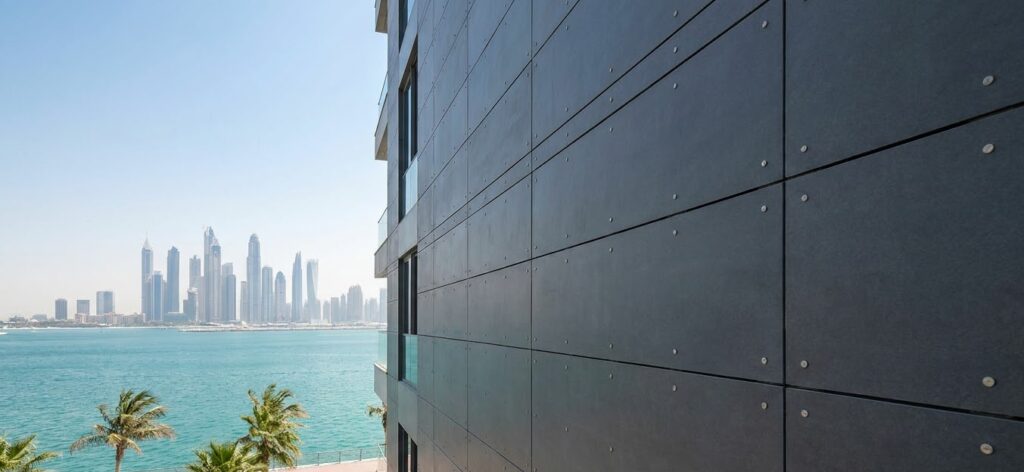
Salt air does not look like a problem. It is invisible. It settles on walls, fixings, and panel faces quietly. Then, over months and years, it corrodes metal components, bleaches paint, lifts coatings, and works moisture into any gap it can find. Buildings near Dubai Marina, JBR, Palm Jumeirah, and the Abu Dhabi Corniche see this process accelerate. The salt concentration in coastal UAE air is high enough that even some metals rated for outdoor use show visible corrosion within a few years of installation.
The right weatherproof building boards UAE coastal projects need are not just water-resistant. They are inorganic. They give salt nothing to work with.
At a Glance
What Coastal Air Actually Does to Building Materials
Salt particles travel on wind. They do not need direct ocean spray to cause damage. In Dubai Marina, Jumeirah, and Abu Dhabi waterfront developments, airborne chlorides settle on every exposed surface: wall panels, window frames, metal fixings, and sealant joints.
When salt deposits combine with the UAE’s sustained humidity, they form an electrolyte on metal surfaces. That electrolyte accelerates corrosion far faster than inland conditions produce. The result shows up as rust staining on walls, corroded fixings behind panel faces, paint blistering on exterior surfaces, and white mineral haze on glass and cladding.
Wood absorbs the salt and moisture together. It swells, rots, and delaminates. Standard metal panels corrode at exposed edges and cut faces. Even 304-grade stainless steel shows surface pitting within five to eight years in high salt deposition zones directly on the UAE waterfront. Painted surfaces blister when moisture works behind the coating through any pinhole or joint gap.
The question for any coastal UAE project is not whether the climate will attack the building envelope. It will. The question is which materials give it the least to work with.
Why Inorganic Materials Win on Coastal UAE Facades
Salt corrodes metal because metal is reactive. It rots wood because wood is organic. It lifts paint because moisture behind a coating breaks the bond between the paint and the substrate.
Fiber cement board is cement, sand, and cellulose fiber. Cement and sand are inorganic minerals. They do not corrode. Salt settling on an FCB surface has no electrochemical reaction to trigger. There is no metal to oxidize, no wood grain to absorb moisture, and no reactive substrate to break down.
This is not a treatment or a coating. It is the composition of the material itself. A weatherproof exterior board Dubai humid climate demands needs to perform without relying on a surface layer that can be scratched, chipped, or degraded by UV before the building has been standing five years.
FCB delivers that. The board face is dense enough to shed salt particles without absorbing them. The cement matrix does not swell when wet and does not crack when it dries out again.
Want a deeper look at how fiber cement handles UAE temperatures above 45°C, coastal humidity, dust storms, and thermal cycling? Read How Fiber Cement Board Performs in UAE Extreme Heat & Humidity for a complete climate performance guide.
For a closer look at moisture and termite resistance, explore Termite-Proof & Moisture-Resistant Boards: Why Fiber Cement Beats Wood in UAE.
For coastal projects, material selection should also include verification of asbestos-free fiber cement boards, particularly when sourcing products from different manufacturers or supply chains.
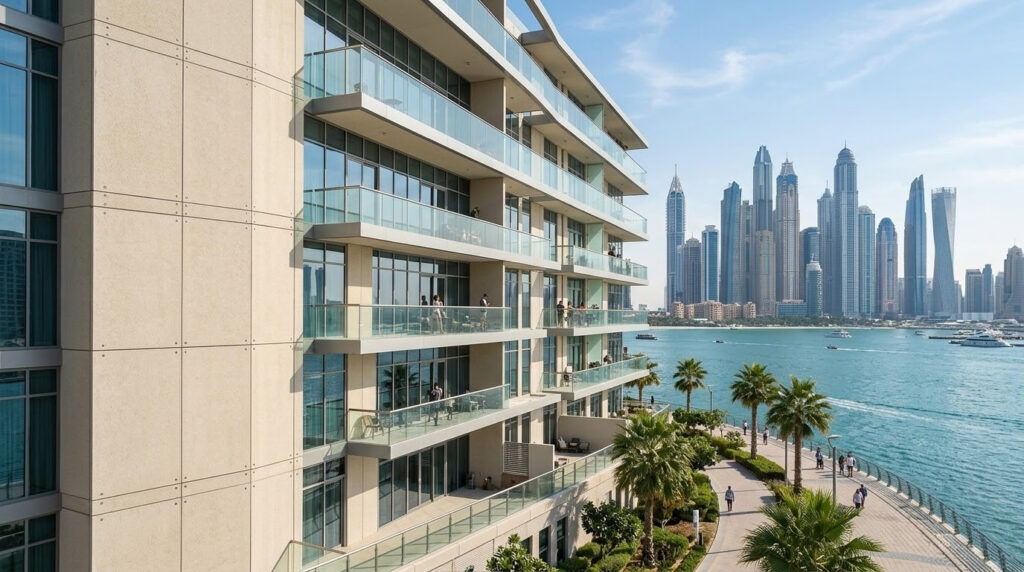
Coastal Cladding Material UAE: The Full Threat Picture
Coastal buildings in the UAE face four conditions simultaneously. Any board specified for exterior use needs to handle all of them.
[ If your project needs both weather protection and fire performance, our guide to Fire-Resistant & Weatherproof Building Boards for UAE Construction compares how fiber cement boards perform across residential, commercial, and industrial projects.]
Salt and humidity. Already covered. The short version: FCB gives salt no reactive surface to work on and no moisture pathway to exploit. It holds its form in sustained humidity without swelling or softening.
Heat and UV. Surface temperatures on exposed UAE walls exceed 60°C in summer. UV radiation in the Gulf is among the highest recorded anywhere. FCB is thermally stable. It does not soften or deform under sustained heat. UV does not degrade the board itself. The paint coat on top may need refreshing over time. The board underneath remains intact.
Thermal cycling. UAE temperatures swing between 14°C winter lows and near 50°C summer highs. Exposed wall surfaces swing harder still. Materials that expand and contract significantly under this cycling put stress on fixings and sealant joints every single day. FCB has a low coefficient of thermal expansion. It moves less than metal panels under the same temperature change, which means less cumulative stress on the facade system over years of use.
Sand abrasion. Shamal winds carry fine desert sand at speed across building surfaces. Softer panel faces pit and erode under repeated abrasion. FCB has a dense cement face. Sand particles shed off the surface rather than cutting into it. The finish remains intact over years of abrasive exposure that would visibly damage softer cladding products.
Salt Air Resistant Board: What the Specification Needs to Confirm
Not every FCB is the same. This point matters in coastal applications more than anywhere else.
FCB is available in standard grade and external grade. Standard grade is for dry interior applications. External grade has higher density, lower moisture absorption, and is tested for sustained outdoor exposure. For any coastal UAE application, external grade FCB is the minimum correct specification.
Beyond the board grade, the full system specification matters. The board face handles salt and moisture. The fixings are where coastal buildings most often fail.
Standard galvanised fixings corrode in UAE coastal conditions. They rust, stain the panel face, and eventually lose their structural hold. The correct fastener specification for coastal UAE cladding is 316-grade stainless steel. This grade resists chloride-driven corrosion significantly better than standard 304-grade, which can show surface pitting in high salt exposure zones within five to eight years.
Sub-frame material needs the same attention. Aluminium sub-frames perform well in coastal conditions because aluminium forms a stable oxide layer that resists further corrosion. Steel sub-frames in coastal environments need appropriate corrosion protection. Untreated steel in a Dubai Marina or Abu Dhabi Corniche application is a maintenance liability from year one.
Exterior Wall Board Dubai Humid Climate: System Design Principles
The board and the fixings are two parts of a three-part system. The third is the drainage design behind the panel.
A rainscreen cavity between the cladding panel and the wall behind it serves two functions in a coastal UAE application. First, it allows any moisture that gets past the outer face to drain downward and exit at the base of the wall rather than sitting against the substrate. Second, it allows air movement behind the panel, which reduces heat build-up in the wall assembly and helps the cavity dry out between rain events.
Weep holes at the base of the cavity need to be clear and correctly positioned from the top of the wall to the bottom. A blocked weep hole defeats the drainage function of the cavity entirely.
Sealant joints between panels need a UV-stable, flexible product. Rigid sealants crack under thermal movement. Once a sealant joint fails on a coastal UAE facade, moisture and salt particles have a direct path into the wall assembly. Inspect and replace sealant joints on a regular maintenance cycle. This is the single most common point of failure on otherwise well-specified coastal facades.
Cut edges on FCB panels must be sealed before installation. The face and back of the board are dense. Cut edges expose the fiber matrix more directly to moisture. In a coastal environment where moisture is constant, unsealed cut edges are a slow moisture entry point that undermines the board’s performance.
What to Ask Before Specifying a Board for Coastal UAE Applications
Before committing to any exterior board for a coastal UAE project, get answers to these questions from the supplier.
Is this an external grade product? Ask for the moisture resistance classification on the product data sheet. If the supplier cannot produce it, the board is not correctly specified for outdoor coastal use.
What fixings does the manufacturer recommend for high salt exposure zones? If the answer is standard galvanised, that is not the right answer for a Dubai Marina or Abu Dhabi Corniche development.
Can the supplier provide assembly documentation for the full system? The board, the sub-frame, the fixings, and the drainage cavity together form the tested performance envelope. A data sheet for the panel alone is not enough.
Is local stock available? In the UAE, a locally manufactured board avoids freight delays, import cost, and the quality consistency issues that come with boards sourced from overseas markets with different climate specifications.
Conclusion
Weatherproof building boards UAE coastal projects need to be inorganic, dense, and correctly specified from board grade through to fixing type. Fiber cement board meets all three requirements when the external grade product is used, 316-grade stainless steel fixings are specified, and the drainage cavity and sealant joints are designed and maintained correctly. The UAE coastal environment is one of the most demanding building conditions in the world. The materials that perform in it long-term are the ones built from the ground up for those conditions, not treated after the fact to approximate that performance.
For projects that also require UAE Civil Defence compliance, explore Fire Rated Cement Board: Regulations & Compliance for UAE Buildings to understand fire ratings, certified systems, and regulatory requirements.
To source external grade fiber cement boards for coastal UAE projects, contact Geminite using this contact form.
Frequently Asked Questions
What makes a board weatherproof for UAE coastal buildings?
It needs to be inorganic, dense, moisture-resistant, and thermally stable so that salt, humidity, heat, and UV have no surface to corrode, absorb into, or degrade.
Is fiber cement board a good coastal cladding material for UAE waterfront developments?
Yes. Its cement and sand composition gives salt no reactive surface to work on, and it does not corrode, swell, or lose structural integrity in sustained coastal humidity.
What fixings should be used with exterior wall boards in Dubai humid climate conditions?
316-grade stainless steel fixings are the minimum correct specification for coastal UAE applications. Standard galvanised fixings corrode under chloride exposure and stain the panel face.
What is the difference between standard grade and external grade FCB for coastal applications?
External grade FCB has higher density and lower moisture absorption, making it the correct specification for any board exposed to outdoor conditions or sustained humidity.
Does salt air damage fiber cement board surfaces over time?
No. Salt has no reactive surface to work on with FCB. The cement and sand face does not corrode, swell, or blister under salt and moisture exposure the way metal, wood, or painted substrates can.
Why does a rainscreen cavity matter on a coastal UAE exterior wall?
It drains any moisture that gets past the panel face and allows the wall assembly to dry out, preventing moisture and salt from sitting against the substrate behind the cladding.
How does fiber cement board handle the thermal cycling of UAE coastal buildings?
FCB has a low coefficient of thermal expansion, so it moves less than metal panels under daily and seasonal temperature swings, reducing cumulative stress on fixings and sealant joints.
What should cut edges of FCB panels be treated with on coastal installations?
All cut edges must be sealed with a compatible sealant before installation to prevent moisture entry through the exposed fiber matrix at panel perimeters.
How often should sealant joints be inspected on a coastal FCB facade in the UAE?
Sealant joints should be inspected on a regular maintenance cycle, as UV degradation and thermal movement cause sealant to crack over time, opening moisture pathways into the wall assembly.
Can FCB be used on balcony soffits and undersides in coastal UAE apartment towers?
Yes. External grade FCB is the correct specification for balcony soffits in coastal buildings where standard gypsum or timber-based boards would deteriorate under the sustained humidity and salt air exposure.
Why Choose Geminite?
When selecting the fire-rated cement board UAE, it is equally important to select a manufacturer as it is to select the proper product.
Geminite delivers high-quality fibre cement boards that are able to satisfy the requirements of current UAE constructions. Our products are designed to be strong, durable, and reliable in fire performance and assist in the maintenance of the recognised fire safety standards.
With Geminite, you benefit from:
- High-quality fibre cement boards.
- Trustworthy fire-resistant wall systems.
- Excellent moisture resistance
- Technical product support
- Consistent product quality
- Suitable solutions for commercial, residential, healthcare, hospitality and industrial applications.
In search of a stable fire-rated cement board UAE provider for your project? Geminite provides quality fire cement board to achieve good fire resistance and durability, and to meet the construction standards of the UAE.
Contact our team today to find the right solution for your residential, commercial, or industrial building.
FAQs
- What is a fire-rated cement board UAE?
Fire-rated cement board UAE: It is a non-combustible fibre cement board used in fire-rated wall and ceiling systems to help slow fire propagation and comply with building safety standards.
- Is fire-rated cement board UAE mandatory for every building?
It varies based on the type of building, occupancy and design. Fire-rated systems are required in many commercial buildings, hospitals, hotels, schools, and high-rise projects to satisfy regulations.
- What is the UAE Civil Defence Fire Board requirement?
The UAE Civil Defence Fire Board requirement assures that fire-rated wall and ceiling assemblies are utilised in accordance with acknowledged testing and in line with acceptable installation procedures.
- What is the FCB fire rating class?
The FCB fire rating class, which is rated in terms of duration of resistance to fire, e.g. 60, 90, or 120 minutes.
- Why is fire-rated building material Dubai important?
Certified fire-rated building material Dubai enhances building safety, regulatory compliance, and minimises damage related to fire.
- Can fire-rated cement boards resist moisture?
Yes. Most fibre cement boards are very resistant to moisture and can therefore be used in the hot and humid climate of the UAE.
- Where can cement boards with fire resistance be installed?
They are usually fitted in the partition walls, ceiling, staircase, lift shafts, service spaces, hospitals, schools, hotels, offices and industrial buildings.
- How do I choose the correct fire rating?
Fire rating required varies with the specifications of your building design and consultant. Always use a tested assembly that suits your project’s fire safety needs.
- Can I use fire-resistant cement board UAE for exterior applications?
Yes. A large number of fire resistant cement board UAE products have been used interiorly as well as exteriority due to their high durability and resistance to weather.
- Reasons why I should select Geminite in fire rated cement board UAE?
Geminite offers a range of best fibre cement board solutions with the support of technical expertise, reliable quality, and products that ensure safe and durable construction projects in the UAE.
At a Glance