

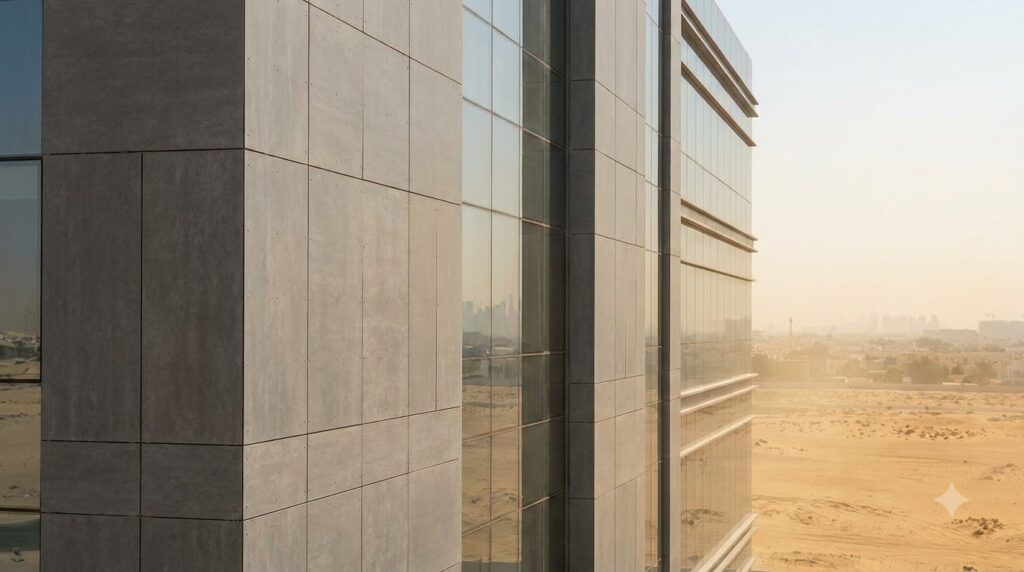
- New
- August 10, 2026
How Fiber Cement Board Performs in UAE Extreme Heat & Humidity
The UAE does not have one climate problem. It has four.
Temperatures climb past 45°C in summer. Exposed wall surfaces go higher still. Coastal humidity sits heavy from June through September. Dust storms hit with enough force to abrade soft surfaces over time. Then winter drops temperatures to 14°C, putting every building material through a 30-degree seasonal swing it has to handle without cracking, warping, or falling apart.
Most building materials handle one or two of these conditions adequately. Few handle all of them without maintenance intervention. Fiber cement board heat resistance UAE construction professionals rely on comes from how the material is made, not from coatings or treatments applied after the fact.
This article explains exactly how FCB performs under each UAE climate condition and what to check before specifying it.
At a Glance
What the UAE Climate Actually Does to Building Materials
Starting with heat. A south-facing wall in Dubai at 2 pm in July is not sitting at 45°C. Surface temperatures on opaque cladding under direct UAE sun regularly exceed 60°C. That heat does not just sit there. It expands the material. When the sun goes down, the surface cools and contracts. Every day. Every year. Materials that cannot handle that cycle develop cracks, buckle at joints, or pull away from fixings over time.
Then add humidity. Abu Dhabi and Dubai sit on the Arabian Gulf coast. From June through September, relative humidity is persistently high. Salt particles travel in that coastal air. They settle on surfaces and accelerate the deterioration of materials that are not built for marine-adjacent conditions.
Add sand. Dust storms carry fine abrasive particles at speed across building surfaces. Anything with a soft face, a painted surface that is not bonded into the material, or a porous texture will show visible erosion within a few years.
Then add UV. The Gulf receives some of the most intense solar radiation on Earth. Colours bleach. Surface coatings break down. Materials that rely on a topcoat for performance lose that protection faster here than almost anywhere else.
That is the full picture. FCB does not solve every problem on every application, but its composition addresses each of these stressors directly.
The board’s environmental performance should also be considered alongside material safety, including verification that the selected product is free from asbestos before procurement.
Fiber Cement Board Heat Resistance UAE: How It Handles Temperature
FCB is made from cement, sand, and cellulose fiber. Cement and sand are inorganic. They do not melt, soften, or deform under heat. The cellulose fiber content is fully encapsulated within the cement matrix and is present in small enough quantities that it does not affect the thermal performance of the board.
The result is a panel that stays dimensionally stable under sustained heat. It does not warp on a hot wall. It does not soften and sag on an exterior soffit facing the afternoon sun.
The bigger test is thermal cycling. Every material expands as it heats and contracts as it cools. The rate at which it does so is expressed as a coefficient of thermal expansion. Aluminium expands and contracts at roughly 23 micrometres per metre per degree Celsius. That is a large movement across a full facade. Steel moves less. Concrete and cement-based materials move even less than that.
FCB sits in the low-expansion range precisely because its primary components are cement and sand. A panel that moves less with temperature change puts less stress on fixings, sealant joints, and sub-frame connections. Fewer stress cycles over years of use mean fewer points of failure on an exterior facade.
This is why FCB performs well where aluminium composite panels have shown issues after years of UAE thermal cycling. The movement is smaller, the joint stress is lower, and the facade stays aligned.
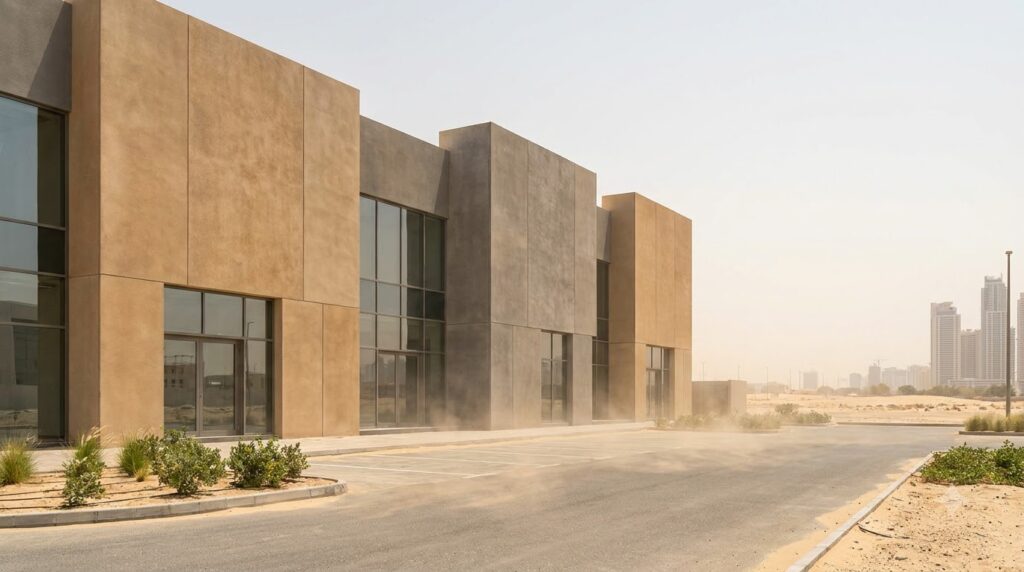
Cement Board Humidity Resistance UAE: Coastal and Inland Performance
For buildings near Dubai Marina, Palm Jumeirah, and the Abu Dhabi Corniche, read Weatherproof Exterior Boards for UAE Coastal Buildings to see how external grade fiber cement boards resist salt air, coastal humidity, and corrosion.
FCB does not absorb water. The cement and sand matrix is dense enough to prevent moisture from penetrating the board under normal conditions.
This matters in two different ways in the UAE. On the coast, where Abu Dhabi, Dubai, Sharjah, and the Northern Emirates sit in persistent high humidity for months at a time, FCB holds its form without swelling. Interior partitions in humid coastal buildings stay flat. Exterior panels do not delaminate or develop the surface bubbling that happens when moisture gets behind a non-porous surface coating on a more absorbent substrate.
Inland, the humidity picture is different. The desert interior is dry for most of the year, but brief rain events bring rapid humidity spikes. A material that absorbs water quickly and dries out quickly experiences repeated expansion and contraction from moisture cycling rather than just thermal cycling. FCB resists this too. Its low absorption rate means moisture spikes have minimal effect on the board’s dimensions or structural integrity.
For wet area applications, cement board humidity resistance UAE projects need is clearest in bathrooms, kitchens, and utility rooms. Steam, splashing, and cleaning cycles with water are regular events. FCB handles all three without the core softening or the surface deteriorating under repeated wet-dry cycles.
For a comparison with timber-based materials, see Termite-Proof & Moisture-Resistant Boards: Why Fiber Cement Beats Wood in UAE.
FCB in Desert Climate: Sand, Dust and UV
Sand abrasion is a specific problem in the UAE that does not appear in most building material guides written for other markets. FCB has a hard, dense face. Sand particles hitting that surface at speed do not erode the board. They shed off rather than cutting into the material.
This is a meaningful difference from softer cladding products. Painted timber, vinyl panels, and some composite products show surface erosion after years of dust storm exposure. The finish degrades. Eventually, the substrate is exposed. Maintenance cycles start.
FCB in desert climate applications holds its surface without the same erosion pattern. The cement face does not pit or scratch under the abrasion conditions the UAE generates. For exterior facades on buildings in inland UAE locations where dust storms are more frequent, this is a performance advantage with direct maintenance cost implications.
UV resistance follows a similar logic. FCB does not rely on a surface coating for its structural performance. Paint is applied on top for aesthetic finish, but the board underneath is unaffected by UV degradation. If the paint coat fades or needs refreshing, the board itself is intact. Contrast this with materials where UV breaks down the surface layer that protects the substrate. Once that layer is compromised, deterioration of the material itself begins.
These weather-resistant properties become particularly valuable when fiber cement boards are specified for exterior walls, façades, soffits and other exposed applications. For a broader comparison of fire-resistant and weatherproof building boards for UAE construction, see our detailed guide.
Moisture Resistant Board Abu Dhabi: What to Specify
Not all FCB is rated equally for moisture exposure. This is the most important specification point and the one most often missed.
FCB comes in standard grade and external grade. Standard grade boards are suited for dry interior applications. External grade boards are manufactured and tested for sustained moisture exposure. The density is higher. The moisture absorption rate is lower. The board is certified for use in wet areas and exterior applications.
For moisture-resistant boards Abu Dhabi developers and contractors need in bathrooms, kitchens, external facades, and soffits, the specification must confirm external grade. A standard grade FCB installed on an exterior wall in Abu Dhabi will perform worse than expected. Not because FCB performs poorly in humidity, but because the wrong grade was specified for the application.
Check the product data sheet before ordering. Look for the moisture resistance classification and confirm it is rated for the application. A reputable supplier provides this documentation without being asked.
What FCB Does Not Do
No building material is without limits, and a fair account of FCB performance includes what it does not offer.
FCB is heavier than gypsum board and aluminium panels. On interior applications where weight affects ceiling grid loads or partition frame specifications, this needs to be accounted for in the structural design.
FCB is not a thermal insulator on its own. It provides a stable, weather-resistant outer face, but building thermal performance in the UAE requires insulation within the wall assembly, whether that is a cavity insulation layer, rigid board insulation behind the panel, or an insulated framing system. FCB covers the outside of that assembly. It is not the assembly itself.
FCB also needs sealing at cut edges. The face and back of the board are dense. Cut edges expose the cement and fiber matrix more directly to moisture. In wet areas and exterior applications, cut edges must be sealed before installation.
For projects where fire performance is also a key specification, it is important to understand how fiber cement boards are incorporated into tested fire-rated wall and ceiling assemblies. Our guide to fire rated cement board regulations and compliance in UAE buildings explains Civil Defence requirements, fire rating classes, and system-level certification.
Conclusion
Fiber cement board heat resistance UAE buildings depend on is a product of the material’s composition. Cement and sand do not warp under heat, absorb coastal humidity, or erode under dust abrasion. The thermal expansion rate is low enough that facade panels stay aligned through years of temperature cycling. Moisture resistance is built in, not applied as a coating. For UAE projects that span desert interior conditions and coastal humidity alike, FCB handles the full range of what the climate creates. The specification needs to match the application: external grade for anything outside or in a wet area, standard grade for dry interior rooms.
To discuss moisture-resistant and heat-resistant fiber cement boards for your UAE project, contact Geminite using this contact form.
Frequently Asked Questions
How does fiber cement board heat resistance in UAE conditions compare to other cladding materials?
FCB has a lower thermal expansion rate than aluminium or steel, which means it moves less with temperature change and puts less stress on fixings and joints over time.
Does cement board humidity resistance in UAE coastal areas need to hold up against salt air?
Yes. FCB does not corrode, and its dense surface resists the moisture and salt particles that coastal air carries, unlike unprotected metal panels or timber-based products.
What is the difference between standard grade and external grade FCB for humid UAE applications?
External grade FCB has higher density and lower moisture absorption, making it the correct specification for wet areas and exterior applications. Standard grade is for dry interiors only.
How does FCB in desert climate conditions handle dust storms?
The dense cement face sheds abrasive sand particles without eroding, keeping the surface intact through conditions that visibly damage softer cladding materials.
Does UV exposure in the UAE affect fiber cement board performance?
UV does not degrade the board itself. Paint on the surface may need refreshing over time, but the FCB substrate remains structurally unaffected.
Is fiber cement board suitable for moisture-resistant applications in Abu Dhabi coastal developments?
Yes, when external grade FCB is specified. It resists sustained humidity, salt air, and direct moisture without swelling or losing structural integrity.
Does FCB need additional waterproofing treatment in UAE wet areas?
Cut edges need sealing before installation, but the board face and back do not require additional waterproofing treatment when external grade FCB is correctly specified.
How does thermal cycling affect FCB panels on UAE exterior facades?
FCB expands and contracts at a low rate relative to metal panels, which reduces cumulative stress on fixings and sealant joints through years of daily temperature swings.
Can fiber cement board be used inside buildings in humid UAE coastal cities?
Yes. For interior wet areas like bathrooms and kitchens, FCB handles steam, splashing, and cleaning cycles without the core softening or the surface deteriorating.
What maintenance does FCB require in UAE extreme heat and humidity conditions?
Minimal. The board does not rot, corrode, or erode. Painted surfaces may need refreshing over time, and sealant joints on exterior applications should be inspected periodically.
Why Choose Geminite?
When selecting the fire-rated cement board UAE, it is equally important to select a manufacturer as it is to select the proper product.
Geminite delivers high-quality fibre cement boards that are able to satisfy the requirements of current UAE constructions. Our products are designed to be strong, durable, and reliable in fire performance and assist in the maintenance of the recognised fire safety standards.
With Geminite, you benefit from:
- High-quality fibre cement boards.
- Trustworthy fire-resistant wall systems.
- Excellent moisture resistance
- Technical product support
- Consistent product quality
- Suitable solutions for commercial, residential, healthcare, hospitality and industrial applications.
In search of a stable fire-rated cement board UAE provider for your project? Geminite provides quality fire cement board to achieve good fire resistance and durability, and to meet the construction standards of the UAE.
Contact our team today to find the right solution for your residential, commercial, or industrial building.
FAQs
- What is a fire-rated cement board UAE?
Fire-rated cement board UAE: It is a non-combustible fibre cement board used in fire-rated wall and ceiling systems to help slow fire propagation and comply with building safety standards.
- Is fire-rated cement board UAE mandatory for every building?
It varies based on the type of building, occupancy and design. Fire-rated systems are required in many commercial buildings, hospitals, hotels, schools, and high-rise projects to satisfy regulations.
- What is the UAE Civil Defence Fire Board requirement?
The UAE Civil Defence Fire Board requirement assures that fire-rated wall and ceiling assemblies are utilised in accordance with acknowledged testing and in line with acceptable installation procedures.
- What is the FCB fire rating class?
The FCB fire rating class, which is rated in terms of duration of resistance to fire, e.g. 60, 90, or 120 minutes.
- Why is fire-rated building material Dubai important?
Certified fire-rated building material Dubai enhances building safety, regulatory compliance, and minimises damage related to fire.
- Can fire-rated cement boards resist moisture?
Yes. Most fibre cement boards are very resistant to moisture and can therefore be used in the hot and humid climate of the UAE.
- Where can cement boards with fire resistance be installed?
They are usually fitted in the partition walls, ceiling, staircase, lift shafts, service spaces, hospitals, schools, hotels, offices and industrial buildings.
- How do I choose the correct fire rating?
Fire rating required varies with the specifications of your building design and consultant. Always use a tested assembly that suits your project’s fire safety needs.
- Can I use fire-resistant cement board UAE for exterior applications?
Yes. A large number of fire resistant cement board UAE products have been used interiorly as well as exteriority due to their high durability and resistance to weather.
- Reasons why I should select Geminite in fire rated cement board UAE?
Geminite offers a range of best fibre cement board solutions with the support of technical expertise, reliable quality, and products that ensure safe and durable construction projects in the UAE.
At a Glance