

- New
- July 2, 2026
Is Fiber Cement Board Cheaper Than Traditional Masonry in UAE?
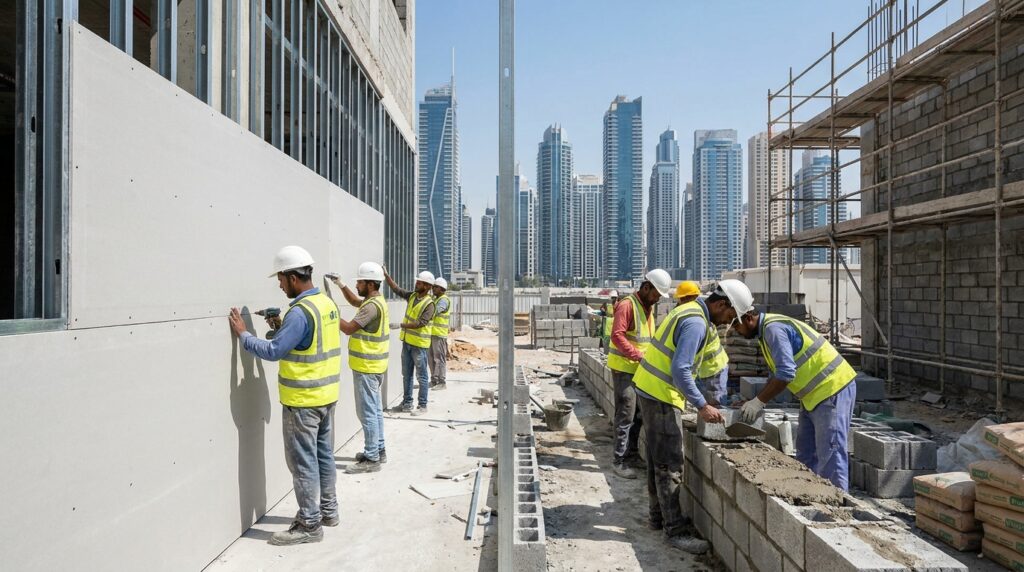
Traditional brick and block masonry has been around for decades in the UAE, and it carries a reputation for being solid and permanent. Fiber cement board partition systems are newer to most site teams, but they are becoming more common on large commercial and residential projects.
The real question in the fiber cement board vs brick UAE comparison is not just which material costs less per square meter. It is which one costs less across the full scope of a project, from procurement through to long-term maintenance?
At a Glance
What Does “Cost” Actually Mean in a Wall System Comparison?
A lot of procurement decisions in the UAE construction get made on material price alone. That approach works when the only variable is the board or block sitting in a supplier’s yard. It breaks down when you factor in everything else that goes into getting a wall built and keeping it standing.
The true cost of any wall system in the UAE includes:
The material itself, which is the number most people compare first.
Labor, which varies a lot between masonry and dry partition systems. Masonry needs skilled bricklayers. Dry partition systems need different trades but are generally faster to complete.
Wet trades and finishing. Brick and block walls need plastering on both sides before any surface finish can go on. That adds materials, labor, and curing time to the program.
Structural load. Heavier walls mean more load on slabs and columns. In high-rise construction, this affects structural design and steel requirements, both of which have direct cost implications.
Program time. A longer construction program costs money in holding costs, site supervision, and delayed handover.
Maintenance over time. A wall that needs repointing, replastering, or repair after five years carries ongoing costs that a more durable system may not.
When you look at the brick vs fiber cement board UAE question through all of these lenses, the answer shifts considerably from what a simple material price comparison would suggest.
Material Cost: Brick vs Fiber Cement Board in the UAE
On a pure material cost basis, the answer depends heavily on the type of masonry being compared and the specification of the FCB system.
Standard clay brick and concrete block are widely available in the UAE and generally carry a competitive base price per unit. However, masonry walls require mortar, reinforcement, plastering materials, and in some applications, additional waterproofing, all of which add to the total material cost before the wall is finished.
Fiber cement board has a higher per-sheet purchase price than a basic block, but an FCB partition system uses metal framing, boards, and jointing materials. No plaster, no mortar, no curing compounds. When the full material bill for a finished wall is compared rather than just the primary material, the gap narrows significantly.
If you’re comparing lightweight wall systems rather than traditional masonry, our Fiber Cement Board vs AAC Blocks: Best Choice for UAE Wall Partitions explains the differences in weight, installation speed, acoustics, and moisture resistance.
Labor and Installation: Where the Real Difference Shows
This is where the fiber cement board vs brick UAE comparison tends to tip most clearly in favor of FCB systems for interior partitions.
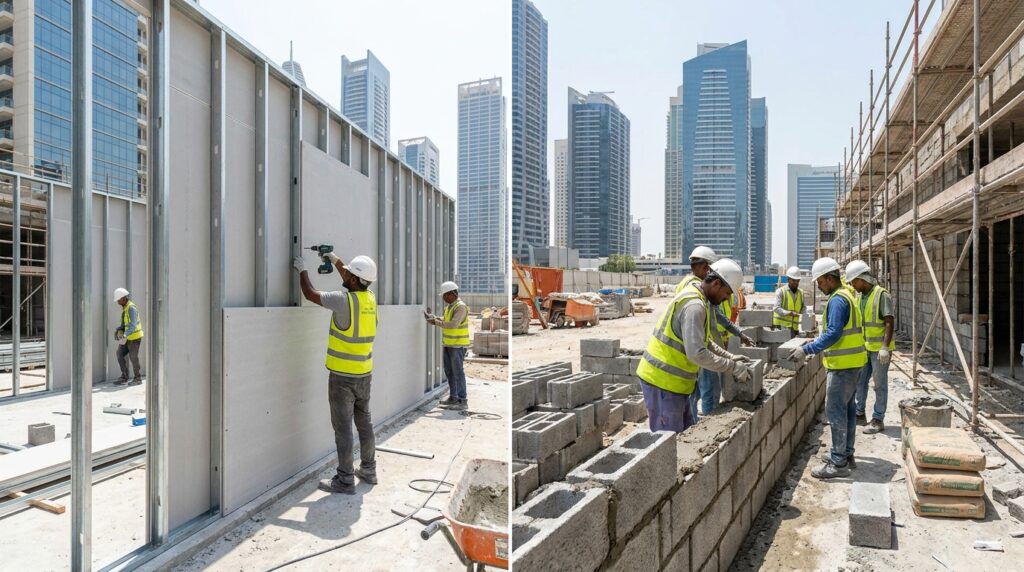
Brick and block masonry is a wet trade. Walls are built course by course, which takes time. Once the blockwork is up, both faces need to be plastered, and plaster needs to cure before painting or tiling can begin. On a large floor plate with hundreds of square meters of internal partitions, this sequence adds weeks to the program.
A fiber cement board stud partition is a dry trade. Boards are fixed to a pre-erected metal frame, joints are taped and finished, and the wall is ready for paint or tile without any curing time. Installation is faster, the process is cleaner, and fewer follow-on trades are held up waiting for the wall to be ready.
Labor costs in the UAE have risen steadily, and faster installation directly reduces the number of hours billed per square meter of wall. For large commercial fit-outs or multi-floor residential towers, the labor saving across an entire project is a number worth calculating before specification decisions are made.
For commercial interiors, you can also read our Cement Board vs Drywall for Commercial Projects in UAE guide to compare durability, moisture resistance, fire performance, and long-term maintenance.
Masonry Alternative Dubai: Why Dry Systems Are Growing
The shift toward dry construction methods in Dubai and across the broader UAE is not accidental. Developers working on tight timelines, high-rise towers where floor loads are carefully managed, and large commercial fit-outs with frequent layout changes have found consistent advantages in lightweight partition systems over traditional masonry.
As a masonry alternative Dubai projects have adopted more broadly, fiber cement board systems offer three things that brick and block cannot easily match: speed, weight reduction, and flexibility for future reconfiguration.
On speed, a dry partition system can be installed and finished in a fraction of the time that plastered blockwork takes. In terms of weight, an FCB stud partition carries a lower dead load per square meter than even lightweight block systems, which matters in high-rise structures where structural engineers are working to tight load limits. On flexibility, a stud partition can be relocated after handover with far less disruption and cost than breaking down and rebuilding a masonry wall.
For interior wall applications, our Fiber Cement Board vs Gypsum Board: Full Comparison for UAE Projects explains when gypsum board is suitable and when fiber cement board is the better long-term solution.
Lightweight Wall Partition Cost UAE: The Full Picture
Industry data from UAE construction sources indicates that lightweight wall partitions in UAE projects generally fall in a competitive range compared to plastered blockwork when total installed cost is measured. The gap is tightest on small, simple partitions and widens in favor of FCB systems on large floor plates, high-specification commercial projects, and any project where the program is a primary driver of cost.
A few specific scenarios where FCB systems tend to deliver better total cost outcomes in the UAE:
High-rise residential towers, where cumulative floor load from block partitions across many floors adds structural cost that a lighter system avoids.
Commercial fit-outs in Dubai and Abu Dhabi, where short construction programs and the likelihood of future reconfiguration make a dry system more practical and cost-effective over the building’s life.
Wet area partitions in bathrooms and kitchens, where masonry needs additional waterproofing treatment before tiling, and FCB does not, reducing both material and labor costs in those specific areas.
Fast-track projects, where getting to handover quickly reduces holding costs for the developer, are a real financial benefit even if the material cost itself is comparable.
If plywood is another material you’re considering, our Fiber Cement Board vs Plywood: Cost, Strength & Durability in UAE Climate guide compares moisture resistance, lifespan, and long-term value in UAE conditions.
Where Traditional Masonry Still Makes Sense
A fair comparison acknowledges that brick and block masonry is not always the more expensive option, and it retains genuine advantages in specific applications.
For external perimeter walls, boundary walls, and structural elements in low to mid-rise construction, masonry remains a strong and cost-competitive choice. Brick walls carry significant thermal mass, which in UAE external wall applications can contribute to energy performance over the building’s lifespan.
For applications where long-term solidity is the primary requirement and program speed is less critical, masonry offers durability that is hard to dispute. A well-built brick or block wall, properly plastered and maintained, will last decades with minimal intervention.
The issue is that most of the situations where masonry costs more than an FCB system are precisely the situations that dominate UAE construction today: high-rise buildings, fast-track commercial projects, and large-scale residential developments where speed and structural efficiency are both priorities.
Conclusion
When total installed cost is measured across materials, labor, program time, structural load, and long-term maintenance, fiber cement board partition systems are competitive with or cheaper than traditional masonry in the majority of interior and high-rise applications.
For external walls and structural elements, masonry retains its place. For interior partitions, fast-track fit-outs, and high-rise construction where every kilogram on the slab matters, FCB systems offer real cost advantages that a material price comparison alone will not show.
Still comparing different construction materials? Explore our Fiber Cement Board vs Other Building Materials: A UAE Comparison for a complete overview of fiber cement board, gypsum board, plywood, AAC blocks, drywall, and traditional masonry for UAE projects.
To get a quote for fiber cement boards for your next UAE project, contact Geminite using this contact form.
Frequently Asked Questions
Is fiber cement board cheaper than brick in the UAE?
On a per-sheet basis, the prices are close, but FCB systems typically cost less in total when labor, plastering, program time, and structural load are all factored in.
What is the lightweight wall partition cost UAE projects should budget for?
Lightweight partition costs in the UAE generally range between AED 70 and AED 150 per square meter, depending on the specification, finish, and fire or acoustic requirements.
Why are developers in Dubai shifting to fiber cement board over masonry?
FCB partition systems install faster, weigh less, and can be reconfigured after handover, all of which reduce total project cost on large commercial and high-rise builds.
Is fiber cement board a reliable masonry alternative in Dubai?
Yes, particularly for interior partitions, wet areas, and high-rise projects where speed and structural load reduction are both priorities.
Does traditional brick masonry cost more to maintain than fiber cement board?
Brick walls may need repointing and replastering over time, while FCB systems generally require less ongoing maintenance, which affects the total lifecycle cost of the wall.
Can fiber cement board be used for external walls in the UAE?
Yes, high-density fiber cement board is specified for exterior facades and cladding and performs well in the UAE climate, though perimeter and boundary walls often still use masonry.
How much faster is fiber cement board to install than brick?
FCB is a dry system with no mortar or plastering required, which can reduce partition installation time significantly on large floor plates compared to plastered blockwork.
Does the weight of a wall system affect total project cost in UAE high-rise buildings?
Yes, heavier walls increase the structural load on slabs and columns, which can raise steel and concrete requirements in the structural design, adding to the overall build cost.
What trades are needed for a fiber cement board partition vs a brick wall?
FCB partitions use light-gauge steel framers and drywall fixers. Brick walls need bricklayers, plasterers, and additional finishing trades, which increases both labor cost and program time.
Is fiber cement board or brick better for wet area partitions in UAE projects?
Fiber cement board is a better specification for wet areas because it does not need additional waterproofing before tiling, which reduces both material and labor costs in bathrooms and kitchens.
At a Glance