

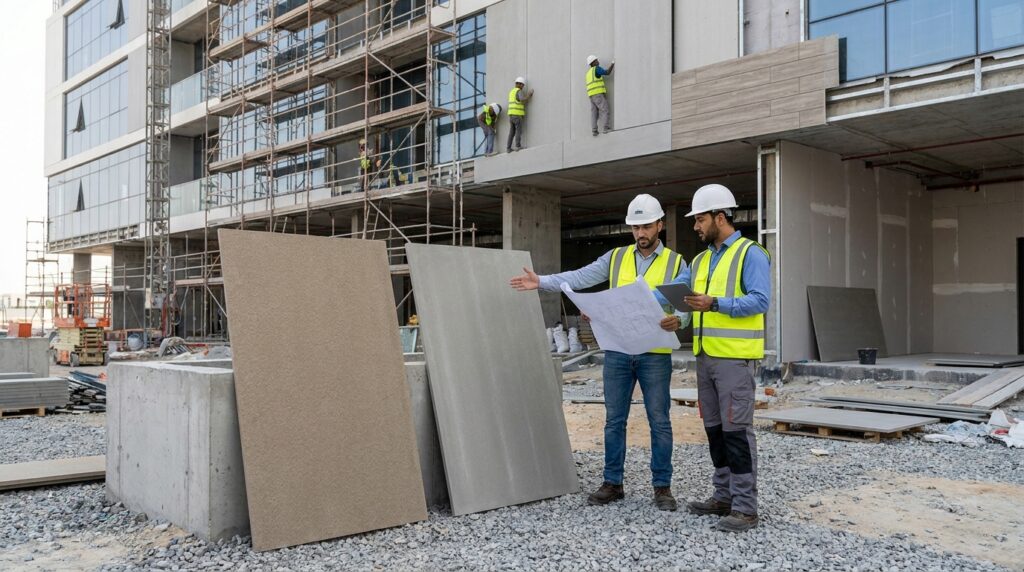
- New
- June 18, 2026
Medium Density vs High Density Fiber Cement Board: Which Do You Need?
Density is one of the most important factors to consider when specifying fiber cement board for a project. Get it right, and the board performs exactly as expected over the life of the building. Get it wrong, and you are looking at rework, compliance issues, or structural failure in load-bearing applications.
For developers and project managers overseeing multiple scopes at once, understanding the FCB density comparison early in the specification process saves time, cost, and site complications later.
At a Glance
What Does Density Mean in Fiber Cement Board?
Density in fiber cement board refers to how much mass is packed into each cubic meter of the board. It is expressed in kg/m3 and is a direct indicator of the board’s strength, impact resistance, and load-bearing capacity.
Medium-density fiber cement board typically falls in the range of 1,000 to 1,200 kg/m3. High-density cement board UAE products generally sit above 1,400 kg/m3, with some high-performance boards going higher depending on the manufacturing process.
The difference in density is not just a number on a data sheet. It determines where the board can be used, how it performs under load, and whether it meets the technical requirements of a given application. Specifying the wrong density for a structural or wet-area application is a compliance risk, not just a performance risk.
Before comparing board densities, it helps to understand the material itself. Read What Is Fiber Cement Board? Properties, Composition & Types Explained to learn about composition, properties, and board categories.
If you are new to fiber cement products, our The Complete Guide to Fiber Cement Boards in UAE covers board manufacturing, applications, benefits, installation methods, and selection criteria in detail.
Medium-Density Fiber Cement Board: Characteristics and Applications
Medium-density fiber cement board is lighter, easier to handle, and more cost-effective per square meter than its high-density counterpart. These characteristics make it the right choice for a wide range of interior applications where load-bearing performance is not the primary requirement.
Interior partitions and wall linings are among the most common uses. Medium-density FCB gives a stable, flat surface that accepts tile, paint, or cladding finishes without the additional cost of a heavier board.
False ceilings and soffits are another strong application. The lower weight of medium-density boards reduces the load on ceiling grids and suspension systems, which matters on large commercial ceilings where cumulative weight adds up quickly.
Dry area wall cladding in corridors, lobbies, and commercial interiors is also well suited to medium-density FCB. The board provides a solid substrate, resists impact from day-to-day use, and holds fixings reliably.
For developers, the cost advantage of medium-density boards in non-structural interior scopes is real. Using high-density board throughout a project where much of the specification calls only for interior linings adds unnecessary material cost without a performance benefit.
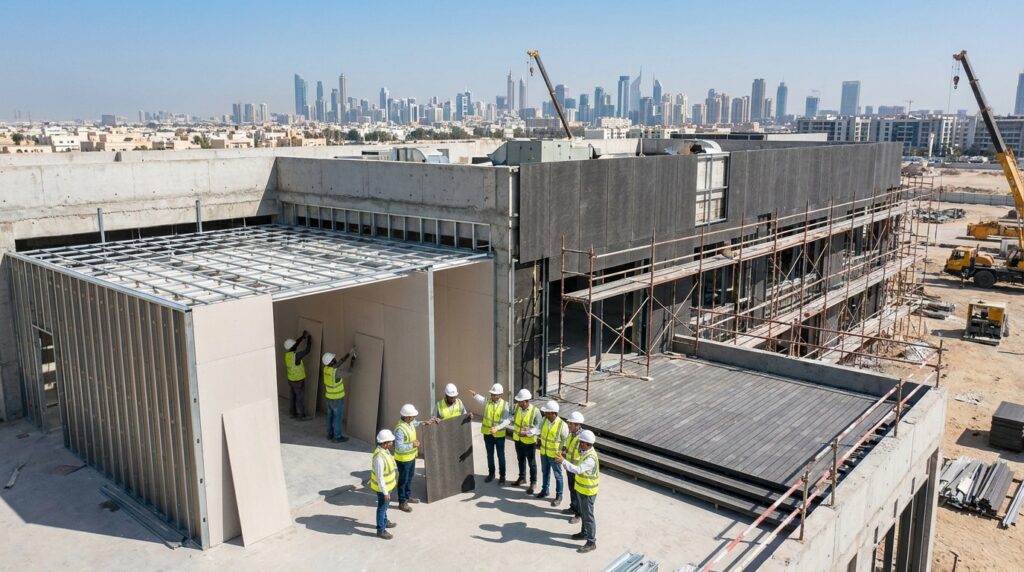
High-Density Cement Board UAE: Characteristics and Applications
High-density cement board UAE products are built for applications where strength, load, and environmental exposure are all factors. The increased mass per cubic meter translates directly into higher compressive strength, better impact resistance, and superior performance in wet and external conditions.
Flooring and floor underlays are where high-density FCB performs most clearly. The board needs to carry point loads, resist deflection under traffic, and remain dimensionally stable under changing conditions. Medium-density boards are not rated for this application and should not be used as a substitute.
Exterior wall cladding and facades require a board that can handle UV exposure, thermal cycling, moisture, and wind load. High-density boards are specified for these applications because they maintain their structural integrity under sustained environmental stress.
Wet area linings in bathrooms, kitchens, and utility areas benefit from high-density boards, particularly in commercial settings where moisture exposure is frequent and intense. While both board types offer some moisture resistance, high-density boards perform more consistently in sustained wet conditions.
Mezzanine floors and structural panels are applications where high-density FCB is specified precisely because of its load-bearing capability. Using medium-density in these areas is a specification error that carries both performance and liability risk.
For project managers coordinating large mixed-use developments, the specification of high-density FCB in structural and external scopes is non-negotiable. The cost premium over medium-density is justified by the performance requirement, and in many cases, by local building code compliance.
FCB Density Comparison: A Side-by-Side View
Understanding where each board type fits becomes clearer when the two are compared directly across key performance criteria.
Weight: medium-density boards are lighter, which simplifies logistics, handling, and installation on upper floors. High-density boards are heavier and require more consideration in lifting, fixing, and structural loading calculations.
Strength: high-density boards carry higher compressive and impact strength. For any application involving foot traffic, point loads, or structural stress, high-density is the correct specification.
Moisture resistance: Both board types offer moisture resistance, but high-density FCB performs better in sustained or high-frequency wet conditions. For splash zones and external applications in the UAE climate, high-density is the safer choice.
Cost: Medium-density fiber cement board is lower in cost per square meter. For large interior scopes, this difference is meaningful at scale. High-density costs more, but the performance it delivers in structural and external applications makes it the right investment in those contexts. Material costs vary based on density, thickness, finish, and sourcing strategy. Read Fiber Cement Board Price in UAE: What to Expect in 2026 for a detailed pricing overview.
Installation: medium-density boards are easier to cut, fix, and maneuver on-site. High-density boards require appropriate tooling and fixing systems to account for their greater mass and hardness.
Board density also affects handling, cutting, and fixing requirements. See How to Install Fiber Cement Board: Step-by-Step Guide for UAE Contractors for installation best practices.
Fire resistance: Both types carry fire resistance properties, but specific ratings depend on the manufacturer and the tested system. Always verify fire classification on the product data sheet against your project’s passive fire protection requirements.
Which Fiber Cement Board Is Stronger?
The question of which fiber cement board is stronger has a direct answer: high-density FCB is stronger. It has higher compressive strength, greater impact resistance, and better performance under load. That is what it is designed for.
But strength alone is not the right basis for specification. A developer who specifies high-density board throughout an entire residential block, including false ceilings and dry area partitions, is paying for performance that those applications do not require. The result is higher material cost, heavier construction, and more complex installation, with no benefit over a correctly specified medium-density board.
The better question for a project manager is not which board is stronger, but which board is right for each specific application in the project scope. A well-specified project uses both medium-density, where interior performance is sufficient, and high-density, where structural load, external exposure, or wet area performance is required.
How to Specify the Right Density for Your Project
Start with the application. Before selecting a board, define the surface, the environment, and the load conditions. Interior dry partition or exterior facade. Ceiling lining or floor underlay. Splash zone or corridor wall. The application determines the density, not the other way around.
Board dimensions and thickness specifications should also be considered alongside density to ensure the selected product meets project requirements.
Review the product data sheet. Density rating, compressive strength, moisture resistance classification, and fire performance data are all listed on a compliant product data sheet. If a supplier cannot provide this document, that is a specification risk.
Check local code requirements. UAE construction codes specify minimum performance standards for materials used in different applications. Your specification needs to match or exceed those requirements, and density is a primary variable in that compliance check.
Coordinate across scopes. On a mixed-use or multi-floor development, FCB is likely specified across multiple trades. A coordinated density schedule, matched to application type, prevents substitution errors on site and keeps procurement consistent.
Conclusion
The decision between medium-density fiber cement board and high-density cement board for UAE projects require is an application-driven one. Medium-density boards are the right choice for interior linings, partitions, and false ceilings where weight and cost matter, and structural load does not.
High-density boards are the right choice for floors, facades, wet areas, and structural panels where strength, load capacity, and environmental performance are the specification requirements.
Neither board is universally superior. The right density is the one that matches the application, meets the code, and holds up over the life of the project.
To discuss fiber cement board specifications for your next project in the UAE, contact Geminite using this contact form.
Frequently Asked Questions
What is medium-density fiber cement board used for?
Medium-density fiber cement board is used for interior partitions, wall linings, false ceilings, and dry area cladding where load-bearing performance is not required.
What is high-density cement board used for in UAE construction?
High-density cement board is used for flooring, exterior facades, wet area linings, and structural panels where strength and moisture resistance are primary requirements.
Which fiber cement board is stronger, medium or high-density?
High-density fiber cement board is stronger, with higher compressive strength and better impact resistance than medium-density boards.
Can medium-density fiber cement board be used for flooring?
No, medium-density FCB is not rated for flooring applications and should not be substituted for high-density board in floor underlay or mezzanine floor scopes.
Is high-density fiber cement board worth the extra cost?
In structural, external, and wet area applications, yes. In interior dry applications, the cost premium is unnecessary because medium-density board meets the performance requirement.
What does FCB density comparison mean in a project specification?
It refers to evaluating medium and high-density boards against the performance requirements of each application in the project to ensure the correct board is specified for each scope.
How do I know which fiber cement board density my project needs?
Define the application first, then match the density to the load, environmental exposure, and code requirements for that surface.
Are high-density cement board UAE products heavier to install?
Yes, high-density boards are heavier and require appropriate handling equipment and fixing systems on site.
Do both medium and high-density fiber cement boards offer fire resistance?
Both types carry fire resistance properties, but specific ratings vary by product and tested system, so always verify the fire classification on the product data sheet.
Can I mix medium and high-density fiber cement board on the same project?
Yes, and on most projects this is the correct approach: medium-density for interior scopes and high-density for structural, external, and wet area applications.
At a Glance