

- New
- August 6, 2025
Top 5 Benefits of Using Fiber Cement Board for Modern Construction
The skyline of the United Arab Emirates is a global symbol of architectural ambition and advanced engineering. From gravity-defying skyscrapers to sprawling, master-planned communities, construction projects in this region demand materials that are not only aesthetically striking but can also perform under the pressure of one of the world’s most challenging climates.
In the search for materials that offer durability, safety, and design flexibility, one engineered solution has consistently proven its value: Fiber Cement Board.
Originally developed as a functional panel, today’s advanced fiber cement board is at the forefront of modern building science, offering a high-performance solution for facades, partitions, and linings. For architects, developers, and contractors in the UAE, a technical understanding of this versatile material’s advantages is crucial for designing and constructing buildings that are safe, sustainable, and engineered to last.
Here are the top five benefits of incorporating fiber cement board into your next project.
At a Glance
- 1. Unmatched Durability in a Harsh Climate
- 2. Superior Fire Resistance for Enhanced Safety
- 3. Excellent Resistance to Moisture and Humidity
- 4. Versatility in Design and Application
- 5. A Commitment to Sustainable Construction
- Conclusion: Building for a Resilient Futurem
- Building with Confidence in the UAE
- Frequently Asked Questions (FAQs)
1. Unmatched Durability in a Harsh Climate
The UAE’s environment is relentlessly demanding. The combination of intense, year-round UV radiation, extreme thermal cycling between day and night, high coastal humidity, and abrasive, wind-driven sand can cause many conventional building materials to fail prematurely. Fiber cement board is specifically engineered to resist these exact challenges.
Its composite matrix of Portland cement, sand, water, and cellulose fibers creates a material with exceptional dimensional stability. Unlike wood, it is inorganic and offers no sustenance to termites, nor will it rot. Unlike polymer-based materials, its mineral base ensures it does not become brittle or lose its integrity under prolonged UV exposure.
This inherent toughness means that building facades and external elements retain their structural integrity and intended appearance for decades, significantly reducing the building’s life-cycle cost by minimizing the need for maintenance and replacement.
2. Superior Fire Resistance for Enhanced Safety
In a region defined by high-rise residential towers, bustling commercial hubs, and large-scale public buildings, fire safety is a paramount concern governed by rigorous regulations like the UAE Fire and Life Safety Code of Practice. This is an area where fiber cement board provides a distinct and critical advantage.
The material is classified as non-combustible. Its composition is fundamentally inert and will not ignite when exposed to direct flame or high heat, earning it the highest fire-resistance ratings (typically Class A or A1). In the event of a fire, it does not contribute to the propagation of flames along a surface and, crucially, does not release toxic smoke or fumes. Utilizing fiber cement board for internal partitions, wall linings, and ceiling systems is a key strategy in a building’s passive fire protection plan.
It enhances fire compartmentalisation, slowing the spread of fire between zones and allowing more time for occupants to evacuate safely, thereby providing an essential element of life safety.
3. Excellent Resistance to Moisture and Humidity
For any construction project along the UAE’s extensive coastline, humidity is a constant environmental factor to be managed. Persistent high humidity can lead to the growth of mold and mildew, compromise the integrity of finishes, and cause hygroscopic materials like traditional gypsum board to swell, weaken, and degrade.
Fiber cement board offers a robust solution to this problem. It has a very low rate of water absorption and exhibits high dimensional stability, meaning it will not deform, swell, or disintegrate when exposed to damp conditions. This makes it the ideal specification for:
- Wet Areas: Bathrooms, kitchens, ablution areas, and laundry rooms, where it serves as a reliable substrate for tile.
- External Applications: Soffits, eaves, and as a component in ventilated rainscreen facade systems.
- High-Traffic Zones: Lobbies and corridors where frequent cleaning with water is required.
By preventing moisture-related damage, fiber cement board contributes to a healthier indoor air quality by inhibiting mould growth and ensures the long-term durability of the building assembly.
4. Versatility in Design and Application
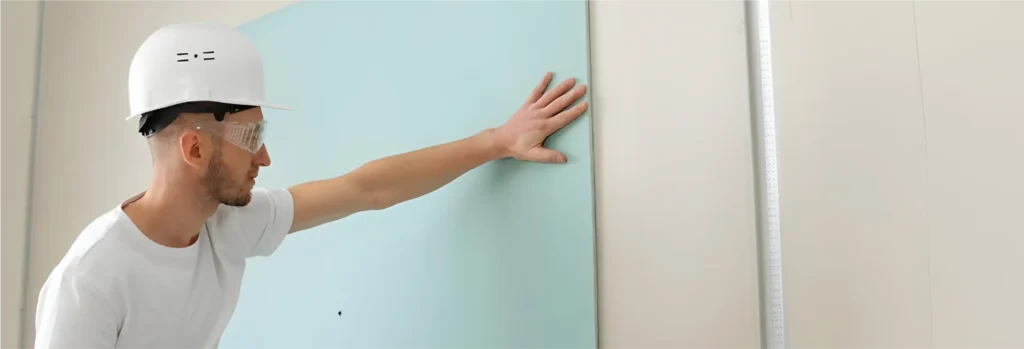
The days of functional but creatively limiting building panels are long gone. Modern fiber cement board is a highly adaptable material, offering architects significant freedom to achieve their design intent without compromising on performance.
Its versatility is twofold:
- Application Flexibility: It can be specified for a vast array of applications, including external facades, internal partitions, decorative wall linings, acoustic ceilings, and durable flooring substrates. Its inherent strength and rigidity make it suitable for creating large, sleek, seamless surfaces as well as complex, layered architectural designs.
- Aesthetic Versatility: The smooth, stable surface of a fiber cement board is an ideal canvas for a variety of finishes. It can be easily painted, finished with a thin coat of plaster for a textured look, or have tiles and stone veneers directly applied to it. Some manufacturers even offer boards with an embossed wood-grain texture, providing the timeless aesthetic of timber without any of its durability drawbacks in a hot, humid climate.
5. A Commitment to Sustainable Construction
As the UAE continues to champion green building initiatives like the Estidama framework, the specification of sustainable construction materials has become a core principle of responsible design. Fiber cement board aligns well with these goals.
Its primary components, cement and sand, are stable, locally available materials. The most significant contribution to sustainability, however, is derived from its exceptional lifespan and low maintenance requirements. This durability directly impacts a building’s life-cycle assessment.
By creating building envelopes and internal structures that last longer and require fewer repairs, fiber cement board reduces the long-term consumption of materials and the generation of construction waste, thereby lowering the building’s overall embodied carbon footprint over its lifetime.
Conclusion: Building for a Resilient Future
In modern construction, material selection is a critical decision that influences a project’s safety, longevity, and environmental impact. Fiber cement board presents a compelling set of technical benefits that directly address the challenges and aspirations of building in the UAE. Its unmatched resilience against climate, fire, and moisture, combined with its boundless design versatility and sustainable credentials, makes it an intelligent, evidence-based choice for professionals.
Building with Confidence in the UAE
Choosing the right materials is the foundation of any successful construction project. As a leading manufacturer in the UAE, we are dedicated to producing high-performance cement boards that meet the nation’s most demanding standards. Our commitment is to quality, innovation, and durability.
Explore our range of fiber cement board solutions or contact our technical team to discuss how we can support your next project.
Frequently Asked Questions (FAQs)
Q: Is fiber cement board completely waterproof?
While fiber cement board is highly water-resistant and will not rot or swell, it should be considered a water-resistant, not a waterproof, material. In applications with direct and continuous water exposure, it should be used as part of a correctly detailed system that includes an appropriate waterproof membrane or vapour barrier.
Q: How does the weight of fiber cement board compare to other materials?
Fiber cement board is a dense material and is therefore heavier than traditional gypsum board or wood-based sheathing of the same thickness. This additional weight must be accounted for in the structural design of the frame.
However, its strength often means a single layer can achieve the impact resistance or acoustic performance that might require multiple layers of other materials.
Q: What is the typical lifespan of a fiber cement board facade?
When installed correctly as part of a well-designed system, a fiber cement board facade can last for 50 years or more. The longevity of the finish (e.g., paint) is dependent on the quality of the coating applied, but the board substrate itself remains stable.
Q: Can fiber cement boards be curved for architectural designs?
Yes, thinner sheets of fiber cement board (typically 6mm or 8mm) have a degree of flexibility and can be installed over a curved frame. Manufacturers provide technical data sheets specifying the minimum bending radius for each board thickness to avoid stress fractures.
At a Glance
- 1. Unmatched Durability in a Harsh Climate
- 2. Superior Fire Resistance for Enhanced Safety
- 3. Excellent Resistance to Moisture and Humidity
- 4. Versatility in Design and Application
- 5. A Commitment to Sustainable Construction
- Conclusion: Building for a Resilient Futurem
- Building with Confidence in the UAE
- Frequently Asked Questions (FAQs)