

- New
- September 29, 2026
Is Fiber Cement Board Worth the Price in UAE? Cost vs Long-Term Value
Fiber cement board costs more than gypsum board. Per square meter, per sheet, by almost any upfront measure, FCB is the more expensive material. So the question is fair: is it actually worth it?
The honest answer is: it depends entirely on where you are using it.
In the right application, FCB pays for itself through avoided repairs, fewer replacements, and lower maintenance over the life of the building. In the wrong application, you are spending more money for performance you do not need. This article gives you the cost logic to make that call clearly for your own project.
At a Glance
What You Are Actually Paying More For
Gypsum board is a soft mineral core between two paper sheets. It is light, smooth, and cheap to manufacture. It works well in dry conditions. Under moisture, impact, or sustained heat, it degrades.
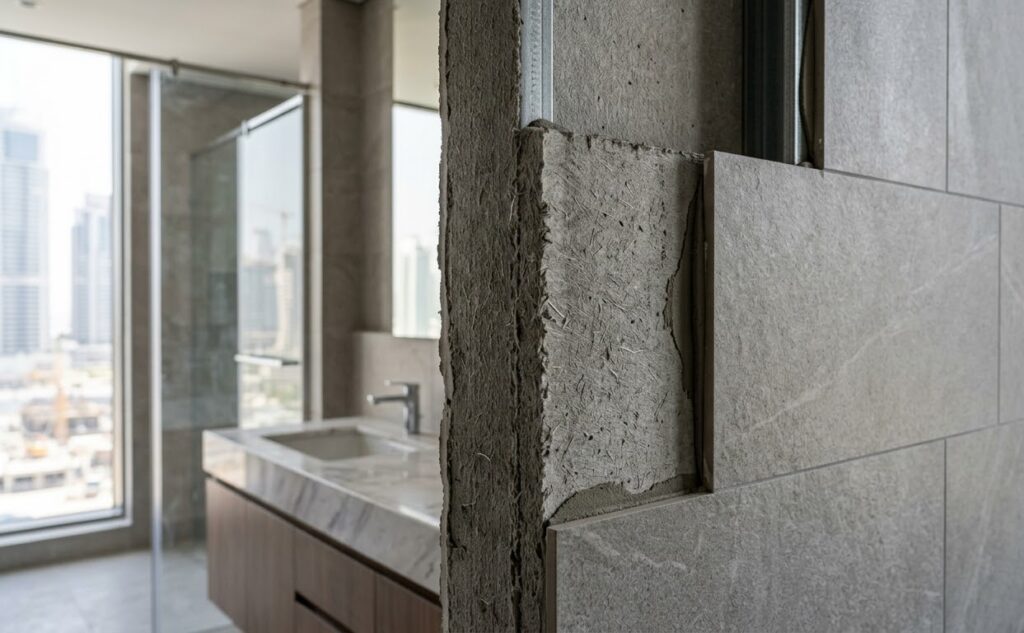
Fiber cement board is cement, sand, and cellulose fiber pressed into a dense sheet. No paper facing. No soft core. It does not absorb water, dent under impact, or break down in heat. The manufacturing process is more intensive, the raw materials cost more, and the board weighs more. All of that is in the price.
For a closer look at how board thickness affects cost, including 6mm options and suitable applications, read our guide to 6mm fiber cement board price in UAE.
The question is not whether the premium is real. It is. The question is whether the performance gap creates enough avoided cost in your specific application to justify paying it.
Where FCB Is Worth the Price
Bathrooms and wet rooms. This is the clearest case. A gypsum partition wall in a bathroom does not fail immediately. It fails slowly. Water works behind tiles through grout lines and failed sealant. The gypsum core absorbs it. Over three to five years, the board softens, tiles loosen, mold begins growing in the cavity, and the wall needs to be stripped and rebuilt.
That repair in the UAE is not cheap. Stripping tiles, removing failed board, reboarding, retiling, and regrouting a single bathroom wall runs from AED 3,000 to AED 8,000 depending on scope. In a residential tower with many units, multiply that across every bathroom that fails within the first five years of handover.
FCB in the same bathroom does not absorb water. The tile bond stays intact. The wall stays flat. There is no mold, no repair, and no disruption to the occupant. The board costs more per sheet. The bathroom never costs anything after handover.
For projects where thickness is a key specification, see our guide to 12mm fiber cement board price in UAE and the applications where this thickness may be appropriate.
That is the fiber cement board value-for-money UAE calculation at its most direct.
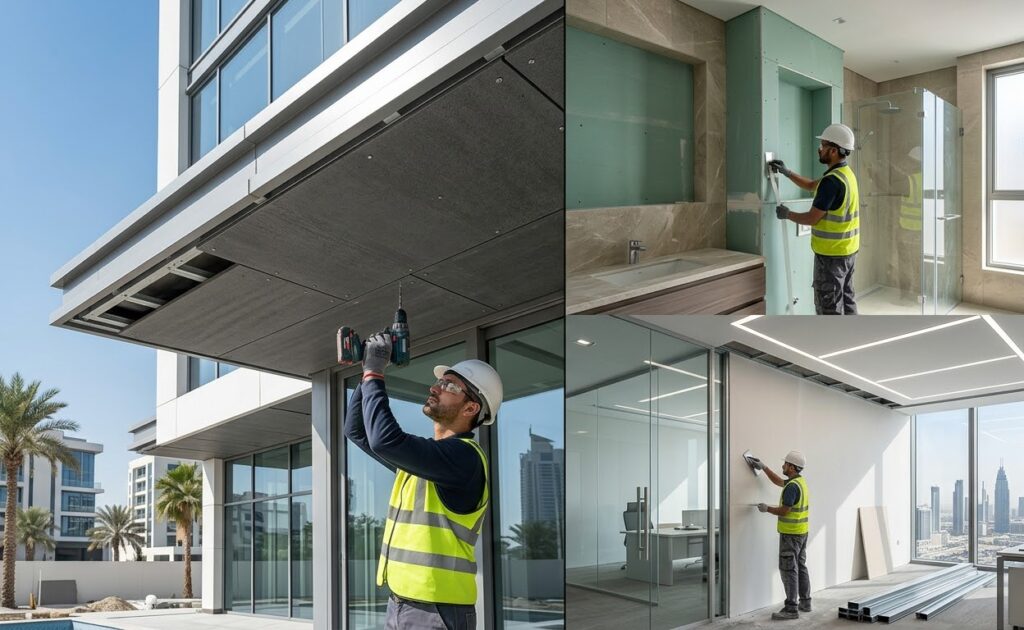
Exterior facades and soffits. Gypsum board cannot go outside. Not even moisture-resistant gypsum. Put it on an exterior soffit in Dubai, and it will deteriorate within one to two years under UV, heat cycling, and humidity. Exterior FCB lasts decades. The cost comparison here is not FCB vs gypsum on price per sheet. It is FCB replaced once vs gypsum replaced repeatedly. Over ten years, the math is not close.
High-traffic commercial spaces. Retail floors, hospital corridors, hotel lobbies, and school buildings all see daily contact from trolleys, bags, and furniture. Gypsum dents, chips at corners, and cracks at joints. In commercial settings, those repairs carry a disruption cost on top of the material cost. FCB does not dent under the same contact. In commercial applications, that durability translates directly into lower facility management costs over the building’s life.
Coastal UAE developments. Buildings in Dubai Marina, Palm Jumeirah, Abu Dhabi Corniche, and coastal Northern Emirates face salt air, sustained humidity, and thermal cycling that accelerates material degradation. FCB is inorganic. Salt has no reactive surface to work on. For developers building in coastal zones, specifying FCB in exposed locations avoids a predictable and well-documented maintenance liability.
Where FCB Is Not Worth the Price Premium
This is the part most FCB content skips. It matters.
In a dry bedroom, living room, or standard office partition with no moisture exposure and no heavy traffic, gypsum board performs the job just as well as FCB. It holds paint, accepts fixings, and lasts the life of the building under those conditions without failing.
Paying the FCB premium in a dry room adds cost without adding performance. The cement board vs gypsum cost long-term argument only applies where the two materials perform differently over time. In a dry interior room, they perform the same. Gypsum is the right call.
For a broader breakdown of fiber cement board pricing by thickness, density, finish and order volume, see our fiber cement board price in UAE buyer’s guide.
The principle is consistent: FCB earns its price premium in conditions that expose the performance gap. Where those conditions do not exist, the premium is unnecessary cost.
The Fiber Cement Board ROI UAE Calculation
Return on investment for a building material works the same way it does anywhere else. You spend more now to avoid spending more later.
For FCB in UAE wet areas, the numbers are straightforward.
FCB costs roughly 20 to 35 percent more per square meter than standard gypsum at comparable thickness. On a single bathroom, the additional material cost at current UAE pricing might add AED 500 to AED 1,500 to the fit-out cost depending on size and specification.
A full bathroom wall rebuild due to gypsum failure runs AED 3,000 to AED 8,000. That repair typically becomes necessary within three to seven years in UAE humidity conditions in a daily-use bathroom.
An AED 1,000 upfront premium to avoid an AED 5,000 repair within five years is a return that most procurement decisions would accept without debate. In a building with fifty bathrooms, the aggregate avoided cost is a material line in the developer’s maintenance budget.
For a detailed breakdown of cement board price per sheet in UAE, including how thickness, sheet size and order quantity affect the final cost, see our complete pricing guide.
The fiber cement board ROI UAE case is clearest in wet areas and exteriors. It is weakest in dry interior rooms where the performance gap between FCB and gypsum does not exist.
For a detailed breakdown of the factors that influence project pricing, see [Cement Board Pricing in UAE: What Affects the Cost and How to Budget].
Is Fiber Cement Board Worth It UAE: The One-Line Test
Before specifying FCB for any surface, ask one question: will this surface face moisture, heavy impact, outdoor exposure, or sustained heat?
If yes, FCB is worth the price premium. The cost of one repair in those conditions covers the price difference many times over.
If no, gypsum board is the right specification. It does the job at lower cost in conditions where the two materials perform identically.
That test cuts through every price comparison and every supplier conversation faster than any other framework.
What a Mixed Specification Looks Like in Practice
Most well-run UAE projects use both materials. They are not in competition on the same walls. They each go where they belong.
Gypsum goes on bedroom partitions, dry office walls, living room ceilings, and any interior surface in a space with no moisture or heavy-impact exposure.
FCB goes on bathroom walls and ceilings, kitchen splash areas, exterior soffits and facades, corridors in commercial buildings, and any surface that faces water, impact, or outdoor conditions.
This split keeps overall material cost as low as possible while ensuring the right board is in every location that would cause problems with the wrong one. Developers who plan this split at the specification stage see lower total material cost and lower post-handover maintenance across the project.
Conclusion
Is fiber cement board worth the price in UAE construction? In bathrooms, kitchens, exterior applications, coastal buildings, and high-traffic commercial spaces, yes. The upfront premium is recovered through avoided repairs that are both predictable and well-documented.
In dry interior rooms where moisture and impact are not factors, no. Gypsum is the correct and more cost-effective specification there. The value of FCB is application-specific. Know the conditions, match the board, and the cost question answers itself.
To get a quote for fiber cement boards for your UAE project, contact Geminite here.
FAQs
Is fiber cement board worth the price in UAE bathrooms specifically?
Yes. The upfront premium is typically recovered well within the first repair cycle, which in UAE bathroom conditions usually happens within three to seven years when gypsum is used instead.
What is the fiber cement board value for money UAE buyers should expect?
Strong in wet areas and exteriors where avoided repair costs exceed the premium several times over. Weak in dry interior rooms where both materials perform identically.
How does cement board vs gypsum cost long term compare in UAE projects?
Gypsum costs less upfront but carries higher total cost over ten years in wet areas due to repair and replacement. In dry areas, gypsum remains cheaper over the full lifecycle.
Is fiber cement board worth it in UAE for a residential villa?
Yes, in bathrooms, kitchen splash areas, exterior soffits, and balcony ceilings. In dry bedrooms and living rooms, gypsum board is the more cost-effective specification.
What is the fiber cement board ROI UAE developers should calculate?
Compare the upfront price premium against the cost of one repair cycle in the relevant application. In UAE wet areas, the repair cost exceeds the premium several times over within a five-year window.
How much more does fiber cement board cost than gypsum in UAE?
Roughly 20 to 35 percent more per square meter. The gap narrows when total installed cost is compared in wet area applications where FCB needs no additional waterproofing before tiling.
Does FCB require less maintenance than gypsum in UAE conditions?
Yes. It does not absorb moisture, dent under normal impact, or degrade in UAE heat and humidity. Maintenance requirements over ten to twenty years are significantly lower in any application involving moisture or heavy use.
What happens if gypsum board is used in a UAE bathroom instead of FCB?
The board absorbs moisture over time, the core softens, tiles loosen, mold grows behind the wall, and the full wall needs to be rebuilt. In UAE conditions, this typically plays out within three to seven years in a daily-use bathroom.
Is FCB worth specifying throughout an entire UAE project?
Not necessarily. A mixed specification using gypsum in dry areas and FCB where conditions demand it gives the best total cost outcome across the project.
Does FCB add value to a UAE property beyond avoiding repairs?
Yes. Lower maintenance requirements reduce service charge costs in managed developments and protect asset value over the full holding period.
At a Glance